


Page 77 - Complete Birds of Britain and Europe (DK - RSPB)
P. 77
BITTERNS AND HERONS
       Order Ciconiiformes    Family Ardeidae        Species Botaurus stellaris
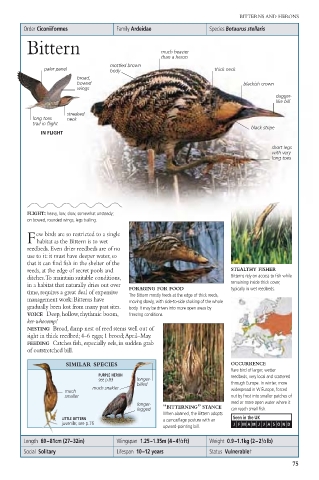
        Bittern                          much heavier
                                         than a heron
                            mottled brown
            paler panel     body                      thick neck
                    broad,
                    bowed                                    blackish crown
                    wings
                                                                      dagger-
                                                                      like bill
                  streaked
         long toes  neck
         trail in flight
                                                               black stripe
           IN FLIGHT
                                                                     short legs
                                                                     with very
                                                                     long toes


        FLIGHT: heavy, low, slow, somewhat unsteady;
        on bowed, rounded wings, legs trailing.
          ew birds are so restricted to a single
        F habitat as the Bittern is to wet
        reedbeds. Even drier reedbeds are of no
        use to it: it must have deeper water, so
        that it can find fish in the shelter of the
        reeds, at the edge of secret pools and            STEALTHY FISHER
        ditches.To maintain suitable conditions,          Bitterns rely on access to fish while
        in a habitat that naturally dries out over  FORAGING FOR FOOD  remaining inside thick cover,
                                                          typically in wet reedbeds.
        time, requires a great deal of expensive  The Bittern mostly feeds at the edge of thick reeds,
        management work: Bitterns have  moving slowly, with side-to-side shaking of the whole
        gradually been lost from many past sites.  body. It may be driven into more open areas by
        VOICE Deep, hollow, rhythmic boom,  freezing conditions.
        ker-whooomp!
        NESTING Broad, damp nest of reed stems well out of
        sight in thick reedbed; 4–6 eggs; 1 brood;April–May.
        FEEDING Catches fish, especially eels, in sudden grab
        of outstretched bill.
                 SIMILAR SPECIES                          OCCURRENCE
                                                          Rare bird of larger, wetter
                         PURPLE HERON                     reedbeds, very local and scattered
                         see p.83  longer-
                                   billed                 through Europe. In winter, more
                        much snakier
                 much                                     widespread in W Europe, forced
                 smaller                                  out by frost into smaller patches of
                                                          reed or more open water where it
                                   longer-  “BITTERNING” STANCE
                                   legged                 can reach small fish.
                                          When alarmed, the Bittern adopts
                LITTLE BITTERN            a camouflage posture with an  Seen in the UK
                juvenile; see p.76                         J  F  M  A  M  JJ A S O  N  D
                                          upward-pointing bill.
       Length  69–81cm (27–32in)  Wingspan  1.25–1.35m (4–4 1 ⁄2ft)  Weight  0.9–1.1kg (2–2 1 ⁄2lb)
       Social  Solitary       Lifespan  10–12 years  Status  Vulnerable†
                                                                          75

