


Page 67 - Complete Birds of Britain and Europe (DK - RSPB)
P. 67
PETRELS AND SHEARWATERS
       Order Procellariiformes  Family Procellariidae  Species Fulmarus glacialis
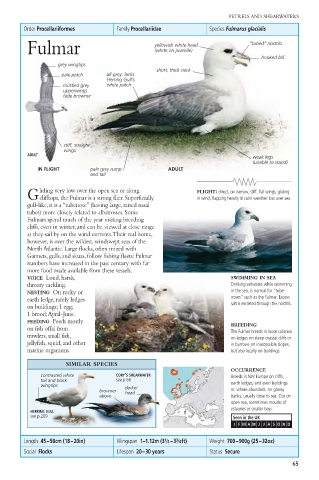
        Fulmar                         yellowish white head    “tubed” nostrils
                                       (white on juvenile)
                                                                  hooked bill
               grey wingtips
                                        short, thick neck
                pale patch  all-grey; lacks
                            Herring Gull’s
                 mottled grey  white patch
                 upperwings
                 fade browner


                 stiff, straight
                 wings
        ADULT
                                                                weak legs
                                                                (unable to stand)
          IN FLIGHT    pale grey rump      ADULT
                       and tail
           liding very low over the open sea or along   FLIGHT: direct, on narrow, stiff, flat wings; gliding
        Gclifftops, the Fulmar is a strong flier. Superficially  in wind, flapping heavily in calm weather low over sea.
        gull-like, it is a “tubenose” (having large, raised nasal
        tubes) more closely related to albatrosses. Some
        Fulmars spend much of the year visiting breeding
        cliffs, even in winter, and can be viewed at close range
        as they sail by on the wind currents.Their real home,
        however, is over the wildest, windswept seas of the
        North Atlantic. Large flocks, often mixed with
        Gannets, gulls, and skuas, follow fishing fleets: Fulmar
        numbers have increased in the past century with far
        more food made available from these vessels.
        VOICE Loud, harsh,                                SWIMMING IN SEA
        throaty cackling.                                 Drinking saltwater, while swimming
        NESTING On rocky or                               in the sea, is normal for “tube-
        earth ledge, rarely ledges                        noses” such as the Fulmar. Excess
        on buildings; 1 egg;                              salt is excreted through the nostrils.
        1 brood;April–June.
        FEEDING Feeds mostly                              BREEDING
        on fish offal from                                The Fulmar breeds in loose colonies
        trawlers, small fish,                             on ledges on steep coastal cliffs or
        jellyfish, squid, and other                       in burrows on inaccessible slopes,
        marine organisms.                                 but also locally on buildings.
                 SIMILAR SPECIES
                                                          OCCURRENCE
           contrasted white   CORY’S SHEARWATER           Breeds in NW Europe on cliffs,
           tail and black     see p.66                    earth ledges, and even buildings
           wingtips             darker
                          browner  head                   or, where abundant, on grassy
                          above                           banks, usually close to sea. Out on
                                                          open sea, sometimes mouths of
                                                          estuaries or smaller bays.
         HERRING GULL
         see p.209                                         Seen in the UK
                                                           J  F  M  A  M  JJ A S O  N  D
       Length  45–50cm (18–20in)  Wingspan  1–1.12m (3 1 ⁄4 –3 3 ⁄4ft)  Weight  700–900g (25–32oz)
       Social  Flocks         Lifespan  20–30 years  Status  Secure
                                                                          65

