


Page 131 - (DK Eyewitness) Travel Guide - Spain
P. 131
BASQUE C OUNTR Y , NA V ARR A & LA RIOJA 129
Basque Culture
The Basques may be Europe’s oldest race. Anthropologists think they could be descended
from Cro-Magnon people, who lived in the Pyrenees 40,000 years ago. The dolmens and
carved stones of their ancestors are evi dence of the Basques’ pagan roots.
Long isolated in their mountain valleys, the Basques preserved their unique language,
myths and art for millennia, almost un touched by other influences. Many families still
live in the isolated, chalet-style stone caseríos, or farm houses, built by their forebears.
Their music and high-bounding dances are unlike those of any other culture, and
their cuisine is varied and imaginative.
The fueros, or ancient Basque laws and rights were suppressed under General Franco,
but since the arrival of democracy in 1975 the Basques have had their own parliament
and police force, having won great autonomy over their own affairs.
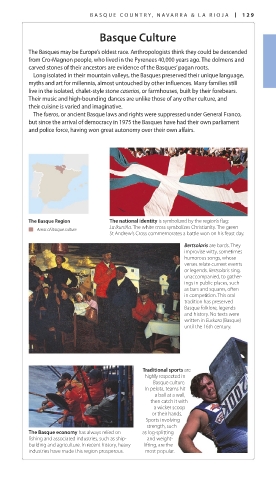
The Basque Region The national identity is symbolized by the region’s flag:
La Ikurriña. The white cross symbolizes Christianity. The green
Areas of Basque culture
St Andrew’s Cross commemorates a battle won on his feast day.
Bertsolaris are bards. They
improvise witty, sometimes
humorous songs, whose
verses relate current events
or legends. Bertsolaris sing,
unaccompanied, to gather
ings in public places, such
as bars and squares, often
in competition. This oral
tradition has preserved
Basque folklore, legends
and history. No texts were
written in Euskara (Basque)
until the 16th century.
Traditional sports are
highly respected in
Basque culture.
In pelota, teams hit
a ball at a wall,
then catch it with
a wicker scoop
or their hands.
Sports involving
strength, such
The Basque economy has always relied on as logsplitting
fishing and associated industries, such as ship and weight
building and agriculture. In recent history, heavy lifting, are the
industries have made this region prosperous. most popular.
128-129_EW_Spain.indd 129 26/09/17 11:53 am

