


Page 136 - (DK Eyewitness) Travel Guide - Spain
P. 136
134 NOR THERN SP AIN
It is Early Gothic, with a carved The serene cloister, dating from
portal depicting the Last the 14th and 15th centuries,
Judgment. There is a Roman- adjoins a 12th-century chapter-
esque cloister, and beside the house. The church also has a
cathedral sits a 9th-century 17th-century tower. Today, the
chapel that is thought to have monks survive by selling local
once been a synagogue. honey and cheese, their own
wine, and by accepting paying
Environs guests (see p561).
To the north is the Bárdenas
Reales, an arid area of lime stone
cliffs and crags. About 20 km o Ujué
(12 miles) west of Tudela is Navarra. * 178. n Plaza Municipal,
the spa town of Fitero, with the 948 73 90 23. _ Virgen de Ujué
12th-century Monasterio de (Sun after 25 April). ∑ ujue.info
Santa María.
The intricately carved portal of An unspoiled hill village, Ujué
Tudela Cathedral commands a high spur at the end
i Monasterio de of a winding road. It has quaint
u Tudela La Oliva façades, cobbled alleys and steep
steps. The impressive and austere
Navarra. * 35,200. £ @ Carcastillo, Navarra. Tel 948 72 50 06.
n Plaza Fueros 5, 948 84 80 58. @ from Pamplona. Open daily. & Iglesia de Santa María is in Gothic
( Sat. _ Santa Ana (26–30 Jul). ∑ monasteriodelaoliva.org style, with a Romanesque
chancel and an exterior lookout
Navarra’s second city is the great French Cistercian monks built gallery. The ruined fortifications
commercial centre of the vast this small monastery on a around the church offer views of
agricultural lands of the Ebro remote plain in the 1100s. The the Pyrenees.
Valley in Navarra, the Ribera. church is simple but adorned On the Sunday after 25 April,
Much of Tudela consists of with rose windows. pilgrims in black capes visit
modern developments, but its the Virgin of Ujué, whose
origins are ancient. Spanning Romanesque image is
the Ebro is a 13th-century displayed in the church.
bridge with 17 irregular arches.
The Old Town has two well-
preserved Jewish districts. p Olite
The Plaza de los Fueros is old Navarra. * 3,900. £ @ n Plaza
Tudela’s main square. It is de Teobaldos 4, 948 74 17 03.
surrounded by houses with ( Wed. _ Medieval Markets
wrought-iron balconies. On (late Aug), Exaltación de la Santa Cruz
some of their façades are paint- (13–19 Sep). ∑ olite.es
ings of bullfights, a re minder
that the plaza was formerly The historic town of Olite was
used as a bullring. founded by the Romans and
The cathedral, begun in 1194, later chosen as a royal resi dence
exemplifies the religious tolera- by the kings of Navarra. Parts
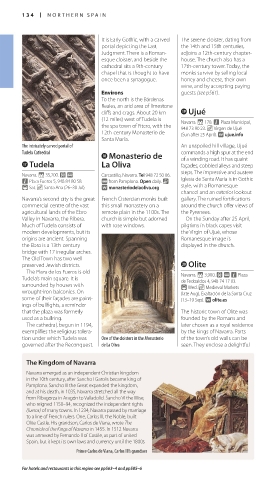
tion under which Tudela was One of the cloisters in the Monasterio of the town’s old walls can be
governed after the Reconquest. de La Oliva seen. They enclose a delightful
The Kingdom of Navarra
Navarra emerged as an independent Christian kingdom
in the 10th century, after Sancho I Garcés became king of
Pamplona. Sancho III the Great expanded the kingdom,
and at his death, in 1035, Navarra stretched all the way
from Ribagorza in Aragón to Valladolid. Sancho VI the Wise,
who reigned 1150–94, recognized the inde pendent rights
(fueros) of many towns. In 1234, Navarra passed by marriage
to a line of French rulers. One, Carlos III, the Noble, built
Olite Castle. His grandson, Carlos de Viana, wrote The
Chronicle of the Kings of Navarra in 1455. In 1512 Navarra
was annexed by Fernando II of Castile, as part of united
Spain, but it kept its own laws and currency until the 1800s.
Prince Carlos de Viana, Carlos III’s grandson
For hotels and restaurants in this region see pp563–4 and pp585–6
134-135_EW_Spain.indd 134 26/09/17 11:00 am
Eyewitness Travel LAYERS PRINTED:
Catalogue template “UK” LAYER
(Source v2.1)
Date 5th December 2012
Size 125mm x 217mm

