


Page 158 - (DK Eyewitness) Travel Guide - Spain
P. 158
156 BARCEL ONA
Although the Orfeó is now
based at the more state-of-the-
art L’Auditori on Carrer de
Lepant (see p195), there is a
concert at the Palau nearly
every night; it is the main
venue for the city’s jazz and
guitar festivals, and world
music, flamenco and symphony
orchestras regularly grace its
flamboyant stage.
The Palau’s new era began
with the completion of the
work carried out by the top
local architect Oscar Tusquets.
An underground concert hall
and an outdoor square for
summer concerts were
added, consolidating the
Palau’s reputation as Barce lona’s
most loved music venue.
w La Llotja
Carrer del Consolat de Mar 2. Map 5
B3. Tel 93 547 88 49. Barceloneta,
Jaume I. Closed to the public (except
twice a year, days vary).
La Llotja (meaning “commodity
exchange”) was built in the
1380s as the headquarters of
the Consolat de Mar. It was
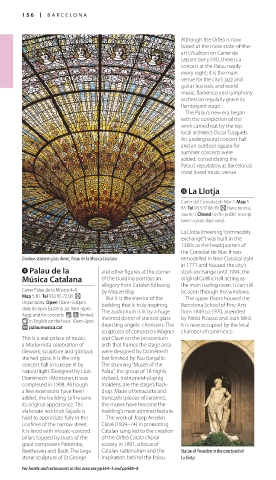
Glorious stained-glass dome, Palau de la Música Catalana remodelled in Neo-Classical style
in 1771 and housed the city’s
q Palau de la and other figures at the corner stock exchange until 1994, the
Música Catalana of the building portrays an original Gothic hall acting as
allegory from Catalan folk song the main trading room. It can still
Carrer Palau de la Música 4–6. by Miquel Blay. be seen through the windows.
Map 5 B1. Tel 932 95 72 00. But it is the interior of the The upper floors housed the
Urquinaona. Open 10am–3:30pm building that is truly inspiring. Barcelona School of Fine Arts
daily (to 6pm Easter & Jul, 9am–6pm The auditorium is lit by a huge from 1849 to 1970, attended
Aug); and for concerts. & 7 limited.
8 in English on the hour, 10am–3pm. inverted dome of stained glass by Pablo Picasso and Joan Miró.
∑ palaumusica.cat depicting angelic choristers. The It is now occupied by the local
sculptures of composers Wagner chamber of commerce.
This is a real palace of music, and Clavé on the proscenium
a Modernista celebration of arch that frames the stage area
tilework, sculpture and glorious were designed by Domènech
stained glass. It is the only but finished by Pau Gargallo.
concert hall in Europe lit by The stunning “Muses of the
natural light. Designed by Lluís Palau”, the group of 18 highly
Domènech i Montaner, it was stylized, instrument-playing
completed in 1908. Although maidens, are the stage’s back-
a few extensions have been drop. Made of terracotta and
added, the building still retains trencadís (pieces of ceramic),
its original appear ance. The the muses have become the
elaborate red-brick façade is building’s most admired feature.
hard to appreciate fully in the The work of Josep Anselm
confines of the narrow street. Clavé (1824–74) in promoting
It is lined with mosaic-covered Catalan song led to the creation
pillars topped by busts of the of the Orfeó Català choral
great composers Palestrina, society in 1891, a focus of
Beethoven and Bach. The large Catalan nationalism and the Statue of Poseidon in the courtyard of
stone sculpture of St George inspira tion behind the Palau. La Llotja
For hotels and restaurants in this area see pp564–5 and pp586–8
156-157_EW_Spain.indd 156 26/09/17 11:00 am

