


Page 159 - (DK Eyewitness) Travel Guide - Spain
P. 159
OLD T OWN 157
e El Born is housed in five adjoining t Basílica de Santa
medieval palaces on Carrer Maria del Mar
Map 5 B3. Jaume I.
Montcada: Berenguer d’Aguilar,
Named after the jousting Baró de Castellet, Meca, Mauri Plaça Sta Maria 1. Map 5 B3. Tel 93
sessions that once took place and Finestres. 310 23 90. Jaume I. Open
in its central boulevard, El Born It opened in 1963 showing 9am–1pm, 5–8:30pm Mon–Sat,
10am–2pm, 5–8pm Sun. & includes
is a tiny pocket of the La Ribera works donated by Jaime guided visit and access to rooftop. 8
district. The village-like atmos- Sabartes, a friend of Picasso. in English: 1:15pm (also Spanish), 2pm,
phere of the neigh bourhood Following Sabartes’ death in 3pm & 5:15pm (also Spanish) daily.
makes it popular with local 1968, Picasso himself donated
residents and young urbanites. paintings, including early This is the city’s only example of
Trendy bars, fashion and design examples. These were a church entirely in the Catalan
shops are juxtaposed with complemented by graphic Gothic style. It took just 55 years
medieval archi tecture. The works, left in his will, and to build, with money donated
14th-century mansions of Carrer 141 ceramic pieces given by merchants and ship builders.
Montcada have remained intact by his widow, Jacqueline. The speed gave it a unity of
and now house high-calibre The strength of the 4,200- style both inside and out. The
galleries and museums, while piece collection is Picasso’s early west front has a 15th-century
the tiny, pedestrianized streets works. These show how, even rose win dow of the Coronation
and squares fanning out from at the ages of 15 and 16, he of the Virgin. More stained glass,
the Mercat del Born are the was painting major works, such from the 15th–18th centuries,
centre of the city’s café culture. as The First Communion (1896) lights the nave and aisles.
The numerous bars and restau- and Science and Charity (1897). The choir and furnishings
rants are a magnet for revellers, The most famous work is were burned in the Civil War
much to the annoyance of the his series of 44 paintings, Las (see p71), adding to the sense of
full-time residents who voice Meninas, which was inspired space and simplicity. The church
their complaints visually by Velázquez’s masterpiece. has great acoustics for concerts.
through the banners hanging
from El Born’s balconies.
r Museu Picasso
Carrer Montcada 15–23. Map 5 B2. Tel
932 56 30 00. Jaume I. Open 9am–
7pm Tue–Sun (to 9:30pm Thu). &
(free under age 18, over 65, 1st Sun
of month & every Sun after 3pm).
8 11am Sun in English (except Aug),
book in advance at 93 256 30 22. 7
∑ museupicasso.bcn.cat
One of Barcelona’s most popular
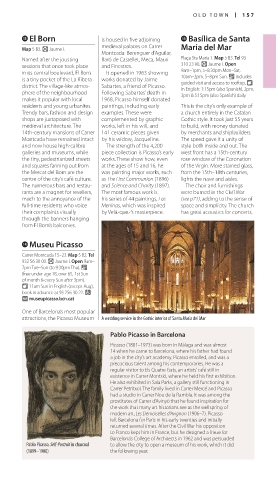
attractions, the Picasso Museum A wedding service in the Gothic interior of Santa Maria del Mar
Pablo Picasso in Barcelona
Picasso (1881–1973) was born in Málaga and was almost
14 when he came to Barcelona, where his father had found
a job in the city’s art academy. Picasso enrolled, and was a
precocious talent among his contemporaries. He was a
regular visitor to Els Quatre Gats, an artists’ café still in
existence in Carrer Montsió, where he held his first exhibi tion.
He also exhibited in Sala Parks, a gallery still func tioning in
Carrer Petritxol. The family lived in Carrer Mercé and Picasso
had a studio in Carrer Nou de la Rambla. It was among the
prostitutes of Carrer d’Avinyò that he found inspiration for
the work that many art historians see as the wellspring of
modern art, Les Demoiselles d’Avignon (1906–7). Picasso
left Barcelona for Paris in his early twenties and initially
returned several times. After the Civil War his opposition
to Franco kept him in France, but he designed a frieze for
Barcelona’s College of Architects in 1962 and was persuaded
Pablo Picasso, Self-Portrait in charcoal to allow the city to open a museum of his work, which it did
(1899–1900) the following year.
156-157_EW_Spain.indd 157 26/09/17 11:00 am

