


Page 256 - (DK Eyewitness) Travel Guide - Spain
P. 256
254 EASTERN SP AIN
w Valencia an enclosed stone patio from
which two staircases ascend
Spain’s third-largest city is sited in the middle of the huerta: to splendidly decorated rooms.
a fertile plain of orange groves and market gardens, which is The larger of the two Salas
one of Europe’s most intensively farmed regions. With its warm Doradas (Golden Chambers),
coastal climate, Valencia is known for its exuberant outdoor on the mezzanine level, has a
multicoloured coffered ceiling
living and nightlife. In March the city stages one of Spain’s most and tiled floor. The walls of the
spectacular fiestas, Las Fallas (see p259), in which giant papier- parliament chamber are
mâché sculptures are burned in the streets. Modern Valencia decorated with frescoes.
is a centre for trade and manufacturing, notably ceramics.
A ferry service connects the city with the Balearic Islands. R Basílica de la Virgen de
los Desamparados
Plaza de la Virgen. Tel 963 91 92 14.
Open 11am–2pm & 5–8pm Mon–Thu;
10:30am–2pm Sun & public hols.
The statue of Valencia’s patron-
ess, the Virgin of the Helpless,
stands above an altar in this
17th-century church, lavishly
adorned with flowers and
candles. She is honoured during
Las Fallas by La Ofrenda (“the
Offering”), a display of flowers in
the square outside the church.
R Cathedral
Plaza de la Reina. Tel 963 91 81 27.
Open 10am–6:30pm Mon–Sat, 2–
6:30pm Sun & public hols (Nov–19 Mar:
10am–5:30pm Mon–Sat). & includes
entry to the museum. Museo: Open as
above. Miguelete: Open daily. & 8
Built originally in 1262, the
cathedral has been added to
over the ages, and its three
doorways are all in different
styles. The oldest is the
Ro manesque Puerta del Palau,
but the main entrance is the
18th-century Baroque portal,
the Puerta de los Hierros.
A unique court meets on
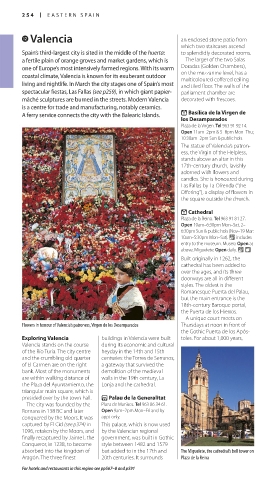
Flowers in honour of Valencia’s patroness, Virgen de los Desamparados Thursdays at noon in front of
the Gothic Puerta de los Após-
Exploring Valencia buildings in Valencia were built toles. For about 1,000 years,
Valencia stands on the course during its economic and cultural
of the Río Turia. The city centre heyday in the 14th and 15th
and the crumbling old quarter centuries: the Torres de Serranos,
of El Carmen are on the right a gateway that survived the
bank. Most of the monuments demo lition of the medieval
are within walk ing distance of walls in the 19th century, La
the Plaza del Ayuntamiento, the Lonja and the cathedral.
triangular main square, which is
presid ed over by the town hall. P Palau de la Generalitat
The city was founded by the Plaza de Manises. Tel 963 86 34 61.
Romans in 138 BC and later Open 9am–2pm Mon–Fri and by
conquered by the Moors. It was appt only.
captured by El Cid (see p374) in This palace, which is now used
1096, retaken by the Moors, and by the Valencian regional
finally recaptured by Jaime I, the government, was built in Gothic
Conqueror, in 1238, to become style between 1482 and 1579
absorbed into the kingdom of but added to in the 17th and The Miguelete, the cathedral’s bell tower on
Aragón. The three finest 20th centuries. It surrounds Plaza de la Reina
For hotels and restaurants in this region see pp567–8 and p591
254-255_EW_Spain.indd 254 26/09/17 11:54 am

