


Page 258 - (DK Eyewitness) Travel Guide - Spain
P. 258
256 EASTERN SP AIN
+ Torres de Serranos
Plaza de los Fueros. Tel 963 91 90 70.
Open 9:30am–7pm daily (to 3pm
Sun). Closed 1 Jan, 1 May, 25 Dec.
& (free Sun).
Erected in 1391 as a triumphal
arch in the city’s walls, this
gateway combines defensive
and decorative features. Its two
towers combine battlements
and delicate Gothic tracery.
E Instituto Valenciano
de Arte Moderno (IVAM)
Calle Guillem de Castro 118. Tel 963
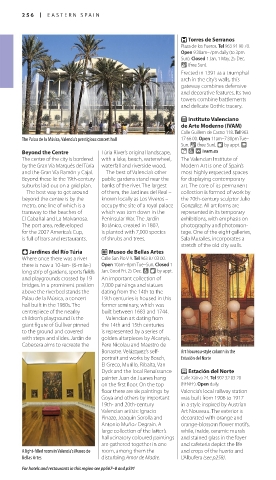
The Palau de la Música, Valencia’s prestigious concert hall 17 66 00. Open 11am–7:30pm Tue–
Sun. & (free Sun). 8 by appt. -
Beyond the Centre Túria River’s original landscape, = 7 ∑ ivam.es
The centre of the city is bor dered with a lake, beach, waterwheel, The Valencian Institute of
by the Gran Vía Marqués del Túria waterfall and riverside wood. Modern Art is one of Spain’s
and the Gran Vía Ramón y Cajal. The best of Valencia’s other most highly respected spaces
Beyond these lie the 19th-century public gardens stand near the for displaying contemporary
suburbs laid out on a grid plan. banks of the river. The largest art. The core of its permanent
The best way to get around of them, the Jardines del Real – collection is formed of work by
beyond the centre is by the known locally as Los Viveros – the 20th-century sculptor Julio
metro, one line of which is a occupy the site of a royal palace Gonzalez. All art forms are
tramway to the beaches of which was torn down in the represented in its temporary
El Cabañal and La Malvarrosa. Peninsular War. The Jardín exhibitions, with emphasis on
The port area, redeveloped Botánico, created in 1802, photography and photomon-
for the 2007 America’s Cup, is planted with 7,000 species tage. One of the eight galleries,
is full of bars and restaurants. of shrubs and trees. Sala Muralles, incorporates a
stretch of the old city walls.
Y Jardines del Río Túria E Museo de Bellas Artes
Where once there was a river Calle San Pío V 9. Tel 963 87 03 00.
there is now a 10-km- (6-mile-) Open 10am–8pm Tue–Sun. Closed 1
long strip of gardens, sports fields Jan, Good Fri, 25 Dec. 7 8 by appt.
and playgrounds crossed by 19 An important collection of
bridges. In a prominent position 2,000 paintings and statues
above the riverbed stands the dating from the 14th to the
Palau de la Música, a concert 19th centuries is housed in this
hall built in the 1980s. The former seminary, which was
centrepiece of the nearby built between 1683 and 1744.
children’s playground is the Valencian art dating from
giant figure of Gulliver pinned the 14th and 15th centuries
to the ground and covered is represented by a series of
with steps and slides. Jardín de golden altarpieces by Alcanyis,
Cabecera aims to recreate the Pere Nicolau and Maestro de
Bonastre. Velázquez’s self- Art Nouveau-style column in the
portrait and works by Bosch, Estación del Norte
El Greco, Murillo, Ribalta, Van
Dyck and the local Renaissance P Estación del Norte
painter Juan de Juanes hang Calle Xátiva 24. Tel 902 32 03 20
on the first floor. On the top (RENFE). Open daily.
floor there are six paintings by Valencia’s local railway station
Goya and others by important was built from 1906 to 1917
19th- and 20th-century in a style inspired by Austrian
Valencian artists: Ignacio Art Nouveau. The exterior is
Pinazo, Joaquín Sorolla and decorated with orange and
Antonio Muñoz Degrain. A orange-blossom flower motifs,
large collection of the latter’s while, inside, ceramic murals
hallucinatory coloured paint ings and stained glass in the foyer
are gathered together in one and cafeteria depict the life
A light-filled room in Valencia’s Museo de room, among them the and crops of the huerta and
Bellas Artes disturbing Amor de Madre. L’Albufera (see p258).
For hotels and restaurants in this region see pp567–8 and p591
256-257_EW_Spain.indd 256 26/09/17 11:54 am

