


Page 259 - (DK Eyewitness) Travel Guide - Spain
P. 259
V ALENCIA 257
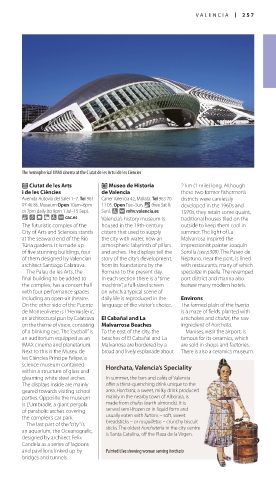
The hemispherical IMAX cinema at the Ciutat de les Arts i de les Ciències
E Ciutat de les Arts E Museo de Historia 2 km (1 mile) long. Although
i de les Ciències de Valencia these two former fishermen’s
Avenida Autovia del Saler 1–7. Tel 961 Carrer Valencia 42, Mislata. Tel 963 70 districts were care lessly
97 46 86. Museum Open 10am–6pm 11 05. Open Tue–Sun. & (free Sat & developed in the 1960s and
or 7pm daily (to 9pm 1 Jul–15 Sep). Sun). 7 ∑ mhv.valencia.es 1970s, they retain some quaint,
& 0 - = 7 ∑ cac.es Valencia’s history museum is traditional houses tiled on the
The futuristic complex of the housed in the 19th-century outside to keep them cool in
City of Arts and Sciences stands cistern that used to supply summer. The light of La
at the seaward end of the Río the city with water, now an Malvarrosa inspired the
Túria gardens. It is made up atmospheric labyrinth of pillars Impressionist painter Joaquín
of five stunning buildings, four and arches. The displays tell the Sorolla (see p309). The Paseo de
of them designed by Valencian story of the city’s development, Neptuno, near the port, is lined
architect Santiago Calatrava. from its foundations by the with restaurants, many of which
The Palau de les Arts, the Romans to the present day. specialize in paella. The revamped
final building to be added to In each section there is a “time port district and marina also
the complex, has a concert hall machine”, a full-sized screen feature many modern hotels.
with four performance spaces on which a typical scene of
including an open-air theatre. daily life is reproduced in the Environs
On the other side of the Puente language of the visitor’s choice. The farmed plain of the huerta
de Monteolivete is L’Hermisfèric, is a maze of fields planted with
an architectural pun by Calatrava El Cabañal and La artichokes and chufas, the raw
on the theme of vision, consisting Malvarrosa Beaches ingre dient of horchata.
of a blinking eye. The “eyeball” is To the east of the city, the Manises, near the airport, is
an auditorium equipped as an beaches of El Cabañal and La famous for its ceramics, which
IMAX cinema and planetarium. Malvarrosa are bordered by a are sold in shops and factories.
Next to this is the Museu de broad and lively esplanade about There is also a ceramics museum.
les Ciències Príncipe Felipe, a
science museum contained Horchata, Valencia’s Speciality
within a structure of glass and
gleaming white steel arches. In summer, the bars and cafés of Valencia
The displays inside are mainly offer a thirst-quenching drink unique to the
geared towards visiting school area. Horchata, a sweet, milky drink produced
parties. Opposite the museum mainly in the nearby town of Alboraia, is
is L’Umbracle, a giant pergola made from chufas (earth almonds). It is
of parabolic arches covering served semi-frozen or in liquid form and
the complex’s car park. usually eaten with fartons – soft, sweet
breadsticks – or rosquilletas – crunchy biscuit
The last part of the “city” is sticks. The oldest horchatería in the city centre
an aquarium, the Oceanografic, is Santa Catalina, off the Plaza de la Virgen.
designed by architect Felix
Candela as a series of lagoons
and pavillions linked up by Painted tiles showing woman serving horchata
bridges and tunnels.
256-257_EW_Spain.indd 257 26/09/17 11:54 am

