


Page 26 - (DK Eyewitness) Travel Guide - Spain
P. 26
24 INTRODUCING SP AIN
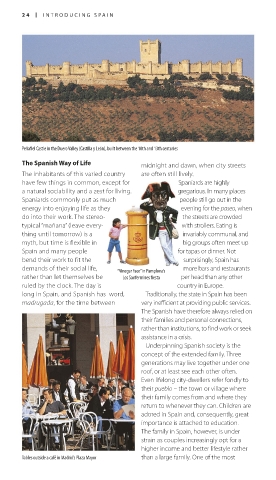
Peñafiel Castle in the Duero Valley (Castilla y León), built between the 10th and 13th centuries
The Spanish Way of Life midnight and dawn, when city streets
The inhabitants of this var ied country are often still lively.
have few things in common, except for Spaniards are highly
a natural sociability and a zest for living. gregarious. In many places
Spaniards commonly put as much people still go out in the
energy into enjoying life as they evening for the paseo, when
do into their work. The stereo the streets are crowd ed
typical “mañana” (leave every with strollers. Eating is
thing until tomorrow) is a invariably communal, and
myth, but time is flexible in big groups often meet up
Spain and many peo ple for tapas or dinner. Not
bend their work to fit the surprisingly, Spain has
demands of their social life, “Vinegar Face” in Pamplona’s more bars and restaurants
rather than let them selves be Los Sanfermines fiesta per head than any other
ruled by the clock. The day is country in Europe.
long in Spain, and Spanish has word, Traditionally, the state in Spain has been
madrugada, for the time between very inefficient at providing public services.
The Spanish have therefore always relied on
their families and personal connec tions,
rather than institutions, to find work or seek
assistance in a cri sis.
Underpinning Spanish society is the
concept of the extended family. Three
generations may live together under one
roof, or at least see each other often.
Even lifelong citydwellers refer fondly to
their pueblo – the town or village where
their family comes from and where they
return to whenever they can. Children are
adored in Spain and, conse quently, great
importance is attached to education.
The family in Spain, however, is under
strain as couples increasingly opt for a
higher income and better lifestyle rather
Tables outside a café in Madrid’s Plaza Mayor than a large family. One of the most
022-027_EW_Spain.indd 24 26/09/17 12:05 pm

