


Page 31 - (DK Eyewitness) Travel Guide - Spain
P. 31
A POR TR AIT OF SP AIN 29
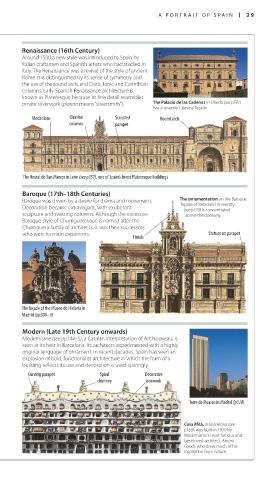
Renaissance (16th Century)
Around 1500 a new style was introduced to Spain by
Italian craftsmen and Spanish artists who had studied in
Italy. The Renaissance was a revival of the style of ancient
Rome. It is distinguished by its sense of symmetry and
the use of the round arch, and Doric, Ionic and Corinthian
columns. Early Spanish Renaissance architecture is
known as Plateresque because its fine detail resembles
ornate silverwork (platero means “silversmith”). The Palacio de las Cadenas in Úbeda (see p501)
has a severely Classical façade.
Medallions Classical Sculpted Round arch
columns parapet
The Hostal de San Marcos in León (see p357), one of Spain’s finest Plateresque buildings
Baroque (17th–18th Centuries)
Baroque was driven by a desire for drama and movement. The ornamentation on the Baroque
façade of Valladolid University
Decoration became extravagant, with exuberant (see p370) is concentrated
sculpture and twisting columns. Although the excessive above the doorway.
Baroque style of Churrigueresque is named after the
Churriguera family of architects, it was their successors
who were its main exponents. Statues on parapet
Finials
The façade of the Museo de Historia in
Madrid (pp308–9)
Modern (Late 19th Century onwards)
Modernisme (see pp144–5), a Catalan interpretation of Art Nouveau, is
seen at its best in Barcelona. Its architects experimented with a highly
original language of ornament. In recent decades, Spain has seen an
explosion of bold, functionalist architecture in which the form of a
building reflects its use and decoration is used sparingly.
Curving parapet Spiral Decorative
chimney ironwork
Torre de Picasso in Madrid (p310)
Casa Milà, in Barcelona (see
p169), was built in 1910 by
Modernisme’s most famous and
best-loved architect, Antoni
Gaudí, who drew much of his
inspiration from nature.
028-029_EW_Spain.indd 29 26/09/17 11:00 am

