


Page 286 - (DK Eyewitness) Travel Guide - Spain
P. 286
284 M ADRID
fail to liquefy, it is said that which, for a while, was the
disaster will befall Madrid. The tallest concrete structure in
church was rebuilt by Ventura the world. The most attractive
Rodríguez after a fire in 1767. part of the square is its centre,
occupied by a massive stone
obelisk built in 1928. In front
q Plaza de España of it is a statue of the author
Cervantes (see p337). Below him,
Map 1 C5. Plaza de España.
Don Quixote (see pp398–9) rides
One of Madrid’s busiest traffic his horse Rocinante while the
intersections and most popular plump Sancho Panza trots
meeting places is the Plaza de alongside on his donkey. On
España, which slopes down the left-hand side is Dulcinea,
towards the Palacio Real (see Don Quixote’s sweetheart.
pp280–81) and the Sabatini
Gardens. In the 18th and
19th centuries the square was w Gran Vía
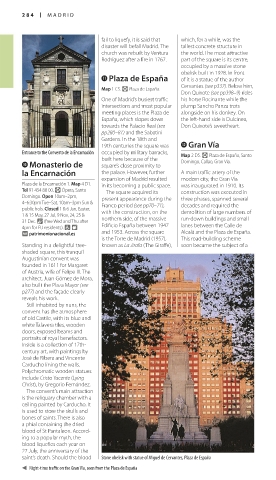
Entrance to the Convento de la Encarnación occupied by military barracks, Map 2 D5. Plaza de España, Santo
built here because of the
0 Monasterio de square’s close proximity to Domingo, Callao, Gran Vía.
la Encarnación the palace. However, further A main traffic artery of the
expansion of Madrid resulted modern city, the Gran Vía
Plaza de la Encarnación 1. Map 4 D1. in its becoming a public space. was inaugurated in 1910. Its
Tel 91 454 88 00. Ópera, Santo The square acquired its construction was executed in
Domingo. Open 10am–2pm, present appearance during the three phases, spanned several
4–6:30pm Tue–Sat, 10am–3pm Sun & Franco period (see pp70–71), decades and required the
public hols. Closed 1 & 6 Jan, Easter, with the construction, on the demolition of large numbers of
1 & 15 May, 27 Jul, 9 Nov, 24, 25 &
31 Dec. & (free Wed and Thu after northern side, of the massive run-down buildings and small
4pm for EU residents). 7 8 Edificio España between 1947 lanes between the Calle de
∑ patrimonionacional.es and 1953. Across the square Alcalá and the Plaza de España.
is the Torre de Madrid (1957), This road-building scheme
Standing in a delightful tree- known as La Jirafa (The Giraffe), soon became the subject of a
shaded square, this tranquil
Augustinian convent was
founded in 1611 for Margaret
of Austria, wife of Felipe III. The
architect, Juan Gómez de Mora,
also built the Plaza Mayor (see
p277) and the façade clearly
reveals his work.
Still inhabited by nuns, the
convent has the atmosphere
of old Castile, with its blue and
white Talavera tiles, wooden
doors, exposed beams and
portraits of royal benefactors.
Inside is a collection of 17th-
century art, with paintings by
José de Ribera and Vincente
Carducho lining the walls.
Polychromatic wooden statues
include Cristo Yacente (Lying
Christ), by Gregorio Fernández.
The convent’s main attraction
is the reliquary chamber with a
ceiling painted by Carducho. It
is used to store the skulls and
bones of saints. There is also
a phial containing the dried
blood of St Pantaleon. Accord-
ing to a popular myth, the
blood liquefies each year on
27 July, the anniversary of the
saint’s death. Should the blood Stone obelisk with statue of Miguel de Cervantes, Plaza de España
Night-time traffic on the Gran Vía, seen from the Plaza de España
284-285_EW_Spain.indd 284 26/09/17 11:54 am

