


Page 290 - (DK Eyewitness) Travel Guide - Spain
P. 290
288 M ADRID
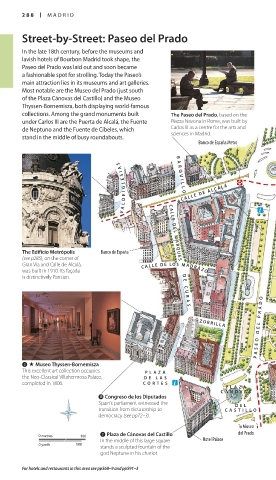
Street-by-Street: Paseo del Prado
In the late 18th century, before the museums and
lavish hotels of Bourbon Madrid took shape, the
Paseo del Prado was laid out and soon became
a fashionable spot for strolling. Today the Paseo’s
main attraction lies in its museums and art galleries.
Most notable are the Museo del Prado (just south
of the Plaza Cánovas del Castillo) and the Museo
Thyssen-Bornemisza, both displaying world-famous
collections. Among the grand monuments built The Paseo del Prado, based on the
under Carlos III are the Puerta de Alcalá, the Fuente Piazza Navona in Rome, was built by
de Neptuno and the Fuente de Cibeles, which Carlos III as a centre for the arts and
sciences in Madrid.
stand in the middle of busy roundabouts.
Banco de Espaňa Metro P L A Z A D E
C I B
E
B
S A L
E
A R S
I Q
S U
E I
L L
G L
I C A L L E D E A L C A L Á
O
E
D
L
A
V
The Edificio Metrópolis Banco de España C A L L E D E L M A R Q U E S
(see p285), on the corner of
Gran Vía and Calle de Alcalá,
was built in 1910. Its façade C A L L E D E L O S M A D R A Z O
is distinctively Parisian. D
E
C
U
O
B
D
A
S
A
R
P PLAZA DE LA LEALTAD
L
Z O R R I L L A
E
D
O
E
S
P A
3 . Museo Thyssen-Bornemisza
This excellent art collection occupies P LAZ A
the Neo-Classical Villahermosa Palace, DE L AS
completed in 1806. C OR TES
P LAZ A
C ÁNOV AS
t Congreso de los Diputados
Spain’s parliament witnessed the DEL
transition from dictator ship to C ASTILL O C A L L E F E L I P E I V
democracy (see pp72–3).
To Museo
0 metres 100 2 Plaza de Cánovas del Castillo del Prado
In the middle of this large square Hotel Palace
0 yards 100
stands a sculpted fountain of the
god Neptune in his chariot.
For hotels and restaurants in this area see pp568–9 and pp591–3
288-289_EW_Spain.indd 288 26/09/17 11:02 am

