


Page 300 - (DK Eyewitness) Travel Guide - Spain
P. 300
298 M ADRID
Exploring the Prado’s Collection
The importance of the Prado is founded on its royal collections.
The wealth of foreign art, including many of Europe’s finest
works, reflects the historical power of the Spanish crown.
The Low Countries and parts of Italy were under Spanish
domination for centuries. The 18th century was an era of
French influence, following the Bourbon accession to the
Spanish throne. The Prado is worthy of repeated visits, but if
you go only once, see the Spanish works of the 17th century.
in Maderuelo, which show a
Romanesque heaviness of line
and forceful characterization.
Spanish Gothic art can be
seen in the Prado in the works
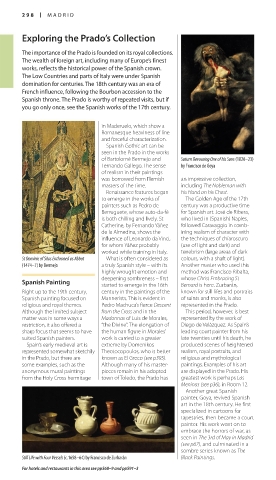
of Bartolomé Bermejo and Saturn Devouring One of his Sons (1820–23)
Fernando Gallego. The sense by Francisco de Goya
of realism in their paintings
was borrowed from Flemish an impressive collection,
masters of the time. including The Nobleman with
Renaissance features began his Hand on his Chest.
to emerge in the works of The Golden Age of the 17th
painters such as Pedro de century was a productive time
Berruguete, whose auto-da-fé for Spanish art. José de Ribera,
is both chilling and lively. St who lived in (Spanish) Naples,
Catherine, by Fernando Yáñez followed Caravaggio in comb-
de la Almedina, shows the ining realism of character with
influence of Leonardo da Vinci, the techniques of chiaroscuro
for whom Yáñez probably (use of light and dark) and
worked while training in Italy. tenebrism (large areas of dark
St Dominic of Silos Enthroned as Abbot What is often considered as colours, with a shaft of light).
(1474–7) by Bermejo a truly Spanish style – with its Another master who used this
highly wrought emotion and method was Francisco Ribalta,
deepening sombreness – first whose Christ Embracing St
Spanish Painting
started to emerge in the 16th Bernard is here. Zurbarán,
Right up to the 19th century, century in the paintings of the known for still lifes and por traits
Spanish painting focused on Mannerists. This is evident in of saints and monks, is also
religious and royal themes. Pedro Machuca’s fierce Descent represented in the Prado.
Although the limited subject from the Cross and in the This period, however, is best
matter was in some ways a Madonnas of Luis de Morales, represented by the work of
restriction, it also offered a “the Divine”. The elongation of Diego de Velázquez. As Spain’s
sharp focus that seems to have the human figure in Morales’ leading court painter from his
suited Spanish painters. work is carried to a greater late twenties until his death, he
Spain’s early medieval art is extreme by Domenikos produced scenes of heightened
represented somewhat sketchily Theotocopoulos, who is better realism, royal portraits, and
in the Prado, but there are known as El Greco (see p395). religious and mythological
some examples, such as the Although many of his master- paintings. Examples of his art
anonymous mural paintings pieces remain in his adopted are displayed in the Prado. His
from the Holy Cross hermitage town of Toledo, the Prado has greatest work is perhaps Las
Meninas (see p36), in Room 12.
Another great Spanish
painter, Goya, revived Spanish
art in the 18th century. He first
specialized in cartoons for
tapestries, then became a court
painter. His work went on to
embrace the horrors of war, as
seen in The 3rd of May in Madrid
(see p67), and culminated in a
sombre series known as The
Still Life with Four Vessels (c.1658–64) by Francisco de Zurbarán Black Paintings.
For hotels and restaurants in this area see pp568–9 and pp591–3
298-299_EW_Spain.indd 298 26/09/17 11:54 am

