


Page 301 - (DK Eyewitness) Travel Guide - Spain
P. 301
MUSEO DEL PR ADO 299
Flemish and Dutch French Painting
Painting Marriages between French
Spain’s long connection with the and Spanish royalty in the
Low Countries naturally resulted 17th century, culminating
in an intense admira tion for the in the Bourbon accession to
so-called Flemish primitives. the throne in the 18th century,
Many exceptional examples brought French art to Spain.
of Flemish and Dutch art now The Prado has eight works
hang in the Prado. St Barbara, attributed to Poussin, among
by Robert Campin, has a quirky them his serene St Cecilia and
intimacy, while Rogier van der Landscape with St Jerome.
Weyden’s The Descent from the The magnificent Landscape
Cross is an unques tioned with the Embarkation of St Paula
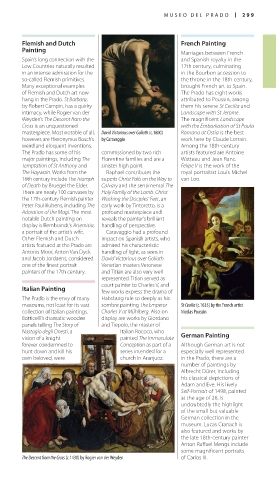
masterpiece. Most notable of all, David Victorious over Goliath (c.1600) Romana at Ostia is the best
however, are Hieronymus Bosch’s by Caravaggio work here by Claude Lorrain.
weird and eloquent inventions. Among the 18th-century
The Prado has some of his commissioned by two rich artists featured are Antoine
major paintings, including The Florentine families and are a Watteau and Jean Ranc.
Temptation of St Anthony and sinister high point. Felipe V is the work of the
The Haywain. Works from the Raphael contributes the royal portraitist Louis-Michel
16th century include The Triumph superb Christ Falls on the Way to van Loo.
of Death by Bruegel the Elder. Calvary and the sentimental The
There are nearly 100 canvases by Holy Family of the Lamb. Christ
the 17th-century Flemish painter Washing the Disciples’ Feet, an
Peter Paul Rubens, including The early work by Tintoretto, is a
Adoration of the Magi. The most profound masterpiece and
notable Dutch painting on reveals the painter’s brilliant
display is Rembrandt’s Artemisia, handling of perspective.
a portrait of the artist’s wife. Caravaggio had a profound
Other Flemish and Dutch impact on Spanish artists, who
artists featured at the Prado are admired his characteristic
Antonis Moor, Anton Van Dyck handling of light, as seen in
and Jacob Jordaens, considered David Victorious over Goliath.
one of the finest portrait Venetian masters Veronese
painters of the 17th century. and Titian are also very well
represented. Titian served as
court painter to Charles V, and
Italian Painting few works express the drama of
The Prado is the envy of many Habsburg rule so deeply as his
museums, not least for its vast sombre painting The Emperor St Cecilia (c.1635) by the French artist
collection of Italian paintings. Charles V at Mühlberg. Also on Nicolas Poussin
Botticelli’s dramatic wooden display are works by Giordano
panels telling The Story of and Tiepolo, the master of
Nastagio degli Onesti, a Italian Rococo, who
vision of a knight painted The Immaculate German Painting
forever condemned to Conception as part of a Although German art is not
hunt down and kill his series intended for a especially well represented
own beloved, were church in Aranjuez. in the Prado, there are a
number of paintings by
Albrecht Dürer, including
his classical depictions of
Adam and Eve. His lively
Self-Portrait of 1498, painted
at the age of 26, is
undoubtedly the highlight
of the small but valuable
German collection in the
museum. Lucas Cranach is
also featured and works by
the late 18th-century painter
Anton Raffael Mengs include
some magnificent portraits
The Descent from the Cross (c.1430) by Rogier van der Weyden of Carlos III.
298-299_EW_Spain.indd 299 26/09/17 11:54 am

