


Page 350 - (DK Eyewitness) Travel Guide - Spain
P. 350
348 CENTR AL SP AIN
The Castles of Castile
The greatest concentration of Spain’s 2,000 castles is
in Castilla y León (now part of Castile), which derived
its name from the word castillo, or castle. In the 10th
and 11th centuries this region was the battleground
between Moors and Christians. Villages and towns
were fortified as protection against one side or the
other. Most of the surviving castles in Castile,
however, were built as noble resi dences after the
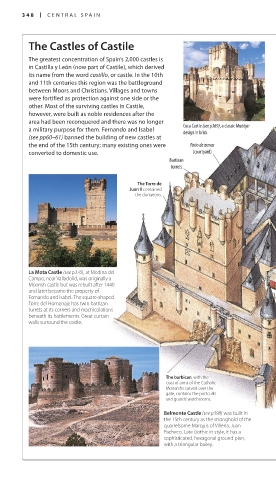
area had been reconquered and there was no longer Coca Castle (see p369), a classic Mudéjar
a military purpose for them. Fernando and Isabel design in brick
(see pp60–61) banned the building of new castles at
the end of the 15th century; many existing ones were Patio de armas
converted to domestic use. (courtyard)
Bartizan
turrets
The Torre de
Juan II contained
the dungeons.
La Mota Castle (see p370), at Medina del
Campo, near Valladolid, was origin ally a
Moorish castle but was rebuilt after 1440
and later became the property of
Fernando and Isabel. The square-shaped
Torre del Homenaje has twin bartizan
turrets at its corners and machicolations
beneath its battlements. Great curtain
walls surround the castle.
The barbican, with the
coat of arms of the Catholic
Monarchs carved over the
gate, contains the portcullis
and guards’ watchrooms.
Belmonte Castle (see p398) was built in
the 15th century as the stronghold of the
quarrelsome Marquis of Villena, Juan
Pacheco. Late Gothic in style, it has a
sophisticated, hexagonal ground plan,
with a triangular bailey.
348-349_EW_Spain.indd 348 26/09/17 11:02 am
Eyewitness Travel LAYERS PRINTED:
Feature template “UK” LAYER
(SourceReport v1.3)
Date 18th October 2012
Size 125mm x 217mm

