


Page 349 - (DK Eyewitness) Travel Guide - Spain
P. 349
INTRODUCING CENTR AL SP AIN 347
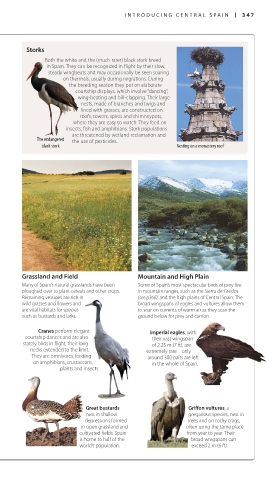
Storks
Both the white and the (much rarer) black stork breed
in Spain. They can be recognized in flight by their slow,
steady wingbeats and may occasionally be seen soaring
on thermals, usually during migrations. During
the breeding season they put on elaborate
courtship displays, which involve “dancing”,
wing-beating and bill-clapping. Their large
nests, made of branches and twigs and
lined with grasses, are constructed on
roofs, towers, spires and chimneypots,
where they are easy to watch. They feed on
insects, fish and amphibians. Stork populations
are threatened by wet land reclamation and
The endangered the use of pesticides.
black stork Nesting on a monastery roof
Grassland and Field Mountain and High Plain
Many of Spain’s natural grasslands have been Some of Spain’s most spectacular birds of prey live
ploughed over to plant cereals and other crops. in mountain ranges, such as the Sierra de Gredos
Remaining vestiges are rich in (see p366), and the high plains of Central Spain. The
wild grasses and flowers and broad wingspans of eagles and vultures allow them
are vital habitats for species to soar on currents of warm air as they scan the
such as bustards and larks. ground below for prey and carrion.
Cranes perform elegant Imperial eagles, with
courtship dances and are also their vast wingspan
stately birds in flight, their long of 2.25 m (7 ft), are
necks extended to the limit. extremely rare – only
They are omnivores, feeding around 300 pairs are left
on amphibians, crustaceans, in the whole of Spain.
plants and insects.
Great bustards Griffon vultures, a
nest in shallow gregarious species, nest in
depressions formed trees and on rocky crags,
in open grassland and often using the same place
cultivated fields. Spain from year to year. Their
is home to half of the broad wingspans can
world’s population. exceed 2 m (6 ft).
346-347_EW_Spain.indd 347 26/09/17 12:05 pm

