


Page 369 - (DK Eyewitness) Travel Guide - Spain
P. 369
C ASTILLA Y LEÓN 367
to note are the carvings on the
retrochoir and, in the apse,
the tomb of a 15th-century
bishop known as El Tostado,
“the Tanned One”, because of
his dark complexion.
Many churches and convents
in Ávila are linked to St Teresa,
who was born in the city. The
Convento de Santa Teresa was
built on the site of her home
within the walls and she also lived
for more than 20 years in the
Monasterio de la Encarnación
outside the walls. There is even a
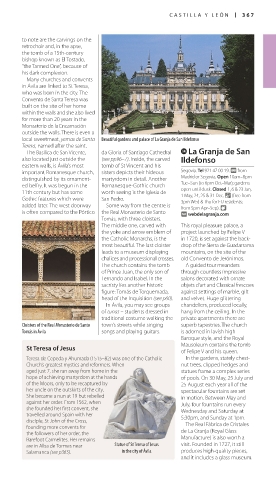
local sweetmeat, yemas de Santa Beautiful gardens and palace of La Granja de San Ildefonso
Teresa, named after the saint.
The Basílica de San Vicente, da Gloria of Santiago Cathedral r La Granja de San
also located just outside the (see pp96–7). Inside, the carved Ildefonso
eastern walls, is Ávila’s most tomb of St Vincent and his
important Romanesque church, sisters depicts their hideous Segovia. Tel 921 47 00 19. @ from
distinguished by its ornament- martyrdom in detail. Another Madrid or Segovia. Open 10am–8pm
ed belfry. It was begun in the Romanesque-Gothic church Tue–Sun (to 6pm Oct–Mar); gardens
11th century but has some worth seeing is the Iglesia de open until dusk. Closed 1, 6 & 23 Jan,
1 May, 24, 25 & 31 Dec. & (free from
Gothic features which were San Pedro. 3pm Wed & Thu for EU residents;
added later. The west door way Some way from the centre is from 5pm Apr–Sep). 8
is often compared to the Pórtico the Real Monasterio de Santo ∑ webdelagranja.com
Tomás, with three clois ters.
The middle one, carved with This royal pleas ure palace, a
the yoke and arrow em blem of project launched by Felipe V
the Catholic Monarchs, is the in 1720, is set against the back-
most beautiful. The last cloister drop of the Sierra de Guadarrama
leads to a museum displaying mountains, on the site of the
chalices and pro cessional crosses. old Convento de Jerónimos.
The church contains the tomb A guided tour meanders
of Prince Juan, the only son of through countless impressive
Fernando and Isabel. In the salons decorated with ornate
sacristy lies another historic objets d’art and Classical fres coes
figure: Tomás de Torquemada, against settings of marble, gilt
head of the Inquisition (see p60). and velvet. Huge glittering
In Ávila, you may see groups chandeliers, produced locally,
of tunas – students dressed in hang from the ceiling. In the
traditional costume walking the private apartments there are
Cloisters of the Real Monasterio de Santo town’s streets while singing superb tapestries. The church
Tomás in Ávila songs and playing guitars. is adorned in lavish high
Baroque style, and the Royal
St Teresa of Jesus Mausoleum contains the tomb
of Felipe V and his queen.
Teresa de Cepeda y Ahumada (1515–82) was one of the Catholic In the gardens, stately chest-
Church’s greatest mystics and reform ers. When nut trees, clipped hedges and
aged just 7, she ran away from home in the statues frame a complex series
hope of achieving martyrdom at the hands of pools. On 30 May, 25 July and
of the Moors, only to be recaptured by 25 August each year all of the
her uncle on the outskirts of the city. spectacular fountains are set
She became a nun at 19 but rebelled in motion. Between May and
against her order. From 1562, when July, four fountains run every
she founded her first convent, she Wed nesday and Saturday at
trav elled around Spain with her 5:30pm, and Sunday at 1pm.
disciple, St John of the Cross, The Real Fábrica de Cristales
founding more convents for
the followers of her order, the de La Granja (Royal Glass
Barefoot Carmelites. Her remains Manufacture) is also worth a
are in Alba de Tormes near Statue of St Teresa of Jesus visit. Founded in 1727, it still
Salamanca (see p365). in the city of Ávila produces high-quality pieces,
and it includes a glass museum.
366-367_EW_Spain.indd 367 26/09/17 11:54 am

