


Page 376 - (DK Eyewitness) Travel Guide - Spain
P. 376
374 CENTR AL SP AIN
k Burgos Cordón, a 15th-century palace
(now a bank) which has a
Burgos. * 180,000. £ @ n Plaza
de Alonso Martínez 7, 947 20 31 25. Franciscan cord motif carved
( Wed, Fri, Sat & Sun. _ San Lesmes over the portal. A plaque
(30 Jan); Pedro and San Pablo (29 Jun). declares that this is where the
∑ turismoburgos.org Catholic Monarchs welcomed
Columbus on his return, in 1497,
Founded in 884, Burgos has from the second of his famous
played a significant political and voy ages to the Americas.
military role in Spanish history. The lacy, steel-grey spires
It was the capital of the united of the cathedral (see pp376–7)
kingdoms of Castile and León are a prominent landmark from
from 1073 until losing that almost anywhere in the city.
honour to Valladolid after the fall On the rising ground behind
of Granada in 1492 (see pp60–61). it stands the restored Iglesia
Flemish triptych inside the collegiate During the 15th and 16th de San Nicolás, whose main
church in Covarrubias centuries, Burgos grew rich feature is a superb altarpiece by
from the wool trade and used Simon of Cologne (1505). Other
j Covarrubias its riches to finance most of churches worth visiting are the
the great art and archi tecture Iglesia de San Lorenzo, with its
Burgos. * 630. @ n Calle
Monseñor Vargas, 947 40 64 61 which can be seen in the city su perb Baroque ceiling, and the
(closed Sun pm, Mon; Mon–Wed today. Less auspicious ly, Franco Iglesia de San Esteban, which
in winter). ( Tue. _ San Cosme chose Burgos as his Civil War houses the Museo del Retablo,
and San Damián (26–27 Sep). headquarters (see pp70–71). open to the public during
The city’s strategic location on summer. The Iglesia de Santa
Named after the reddish caves the main Madrid–France highway Águeda is the place where
on its outskirts, Covarrubias and on the route to Santiago (see El Cid made King Alfonso VI
stands on the banks of the Río pp86–7) ensure many visitors; but swear that he played no part in
Arlanza. Medieval walls sur round even with out this Burgos would the murder of his elder brother,
the charming old centre with its justify a long detour. Despite its King Sancho II (see p360).
arcaded half-timbered houses size and extremes of climate, it is
(see p30). The distinguished one of most agreeable provin cial
collegiate church (closed Tue) capitals in Castilla y León.
shows the historical importance Approach via the bridge of
of Covarrubias: here is the tomb Santa María, which leads into the
of Fernán González, first old quarter through the restored
independent Count of Castile, Arco de Santa María, a gate way
and one of the great figures in carved with statues of var ious
Castilian history. By uniting local worthies. The main bridge
several fiefs against the Moors into the city, however, is the
in the 10th century, he started Puente de San Pablo, where
the rise in Castilian power that a statue commemorates the
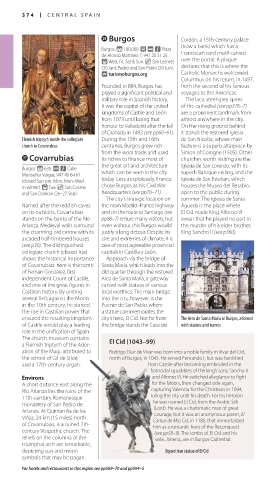
ensured the resulting kingdom city’s hero, El Cid. Not far from The Arco de Santa María in Burgos, adorned
of Castile would play a leading the bridge stands the Casa del with statues and turrets
role in the unification of Spain.
The church museum contains El Cid (1043–99)
a Flemish triptych of the Ador-
ation of the Magi, attributed to Rodrigo Díaz de Vivar was born into a noble family in Vivar del Cid,
the school of Gil de Siloé, north of Burgos, in 1043. He served Fernando I, but was banished
and a 17th-century organ. from Castile after becoming embroiled in the
fratri cidal squabbles of the king’s sons, Sancho II
Environs and Alfonso VI. He switched allegiance to fight
A short distance east along the for the Moors, then changed side again,
Río Arlanza lies the ruins of the capturing Valencia for the Christians in 1094,
11th-century Romanesque ruling the city until his death. For his heroism
monastery of San Pedro de he was named El Cid, from the Arabic Sidi
(Lord). He was a charismatic man of great
Arlanza. At Quintanilla de las courage, but it was an anonymous poem, El
Viñas, 24 km (15 miles) north Cantar de Mío Cid, in 1180, that immortalized
of Covarrubias, is a ruined 7th- him as a romantic hero of the Reconquest
century Visigothic church. The (see pp58–9). The tombs of El Cid and his
reliefs on the columns of the wife, Jimena, are in Burgos Cathedral.
triumphal arch are remark able,
depicting sun and moon Equestrian statue of El Cid
symbols that may be pagan.
For hotels and restaurants in this region see pp569–70 and pp594–5
374-375_EW_Spain.indd 374 26/09/17 11:54 am

