


Page 496 - (DK Eyewitness) Travel Guide - Spain
P. 496
494 SOUTHERN SP AIN
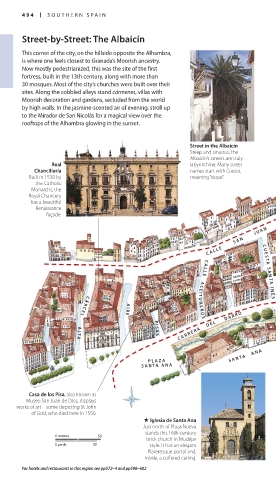
Street-by-Street: The Albaicín
This corner of the city, on the hillside opposite the Alhambra,
is where one feels closest to Granada’s Moorish ancestry.
Now mostly pedes trianized, this was the site of the first
fortress, built in the 13th century, along with more than
30 mosques. Most of the city’s churches were built over their
sites. Along the cobbled alleys stand cármenes, villas with
Moorish decoration and gardens, secluded from the world
by high walls. In the jasmine-scented air of evening, stroll up
to the Mirador de San Nicolás for a magical view over the
roof tops of the Alhambra glowing in the sunset.
Street in the Albaicín
Steep and sinuous, the
Albaicín’s streets are truly
Real labyrinthine. Many street
Chancillería names start with Cuesta,
Built in 1530 by meaning “slope”.
the Catholic
Monarchs, the
Royal Chancery
has a beautiful
Renaissance
façade.
J U A N
S A N
C A L L E C U E S TA S A N TA I N É S C A R N E R O
C A L L E
D A R R O
A I R E
C Á R C E L
A C E I T U N E R O S
D E L
C A R R E R A
P I S A S
A LTA
A N A
S A N TA
P L A Z A
S A N TA A N A
Casa de los Pisa, also known as
Museo San Juan de Dios, displays
works of art – some depicting St John
of God, who died here in 1550.
. Iglesia de Santa Ana
Just north of Plaza Nueva
stands this 16th-century
0 metres 50
brick church in Mudéjar
0 yards 50 style. It has an elegant
Plateresque portal and,
inside, a coffered ceiling.
For hotels and restaurants in this region see pp572–4 and pp598–602
494-495_EW_Spain.indd 494 26/09/17 11:56 am

