


Page 56 - (DK Eyewitness) Travel Guide - Spain
P. 56
54 INTRODUCING SP AIN
Romans and Visigoths
The Romans came to Spain to fight the Cartha ginians and
take possession of the region’s huge mineral wealth. Later,
Hispania’s wheat and olive oil became mainstays of the
empire. It took 200 years to subdue the penin sula, which
was divided in three provinces: Tarraconensis, Lusitania and
Baetica. In time, cities with Roman infrastructure developed.
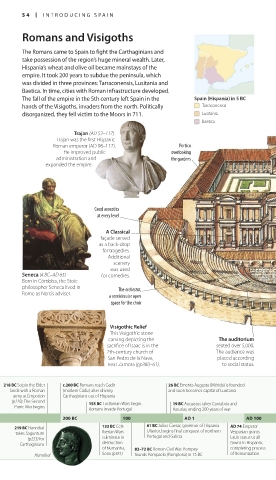
The fall of the empire in the 5th century left Spain in the Spain (Hispania) in 5 BC
hands of the Visigoths, invaders from the north. Politically Tarraconensis
disorganized, they fell victim to the Moors in 711. Lusitania
Baetica
Trajan (AD 53–117)
Trajan was the first Hispanic
Roman emperor (AD 98–117). Portico
He improved public over looking
administration and the gardens
expanded the empire.
Good acoustics
at every level
A Classical
façade served
as a back-drop
for tragedies.
Additional
scenery
was used
Seneca (4 BC–AD 65) for comedies.
Born in Córdoba, the Stoic
philosopher Seneca lived in The orchestra,
Rome as Nero’s adviser.
a semicircular open
space for the choir
Visigothic Relief
This Visigothic stone
carving depicting the The auditorium
sacrifice of Isaac is in the seated over 5,000.
7th-century church of The audience was
San Pedro de la Nave, placed according
near Zamora (pp360–61). to social status.
218 BC Scipio the Elder c.200 BC Romans reach Gadir 26 BC Emerita Augusta (Mérida) is founded
lands with a Roman (modern Cádiz) after driving and soon becomes capital of Lusitania
army at Emporion Carthaginians out of Hispania
(p220). The Second 155 BC Lusitanian Wars begin. 19 BC Augustus takes Cantabria and
Punic War begins
Romans invade Portugal Asturias, ending 200 years of war
200 BC 100 AD 1 AD 100
219 BC Hannibal 133 BC Celt- 61 BC Julius Caesar, governor of Hispania AD 74 Emperor
takes Saguntum Iberian Wars Ulterior, begins final conquest of northern Vespasian grants
(p253) for culminate in Portugal and Galicia Latin status to all
Carthaginians destruction towns in Hispania,
of Numantia, 82–72 BC Roman Civil War. Pompey completing process
Hannibal Soria (p381) founds Pompaelo (Pamplona) in 75 BC of Romanization
054-055_EW_Spain.indd 54 26/09/17 11:52 am

