


Page 61 - (DK Eyewitness) Travel Guide - Spain
P. 61
THE HIST OR Y OF SP AIN 59
Where to See
Mudéjar Spain
The Mudéjares – Muslims who
remained in territories under
Christian occupation – created
a distinctive architectural style
distinguished by its ornamen tal
work in brick, plaster and
ceramics. Aragón, particularly
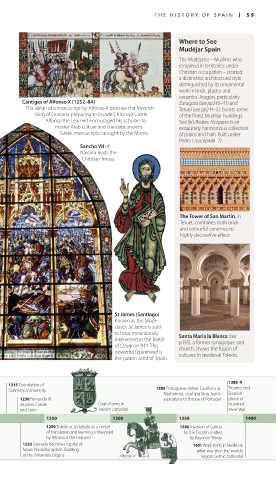
Cantigas of Alfonso X (1252–84) Zaragoza (see pp240–41) and
This detail of a manuscript by Alfonso X portrays the Moorish Teruel (see pp244–5), boasts some
King of Granada preparing to invade Chincoya Castle. of the finest Mudéjar buildings.
Alfonso the Learned encouraged his scholars to Seville’s Reales Alcázares is an
master Arab culture and translate ancient exquisitely harmonious collection
Greek manuscripts brought by the Moors. of patios and halls built under
Pedro I (see pp446–7).
Sancho VII of
Navarra leads the
Christian forces.
The Tower of San Martín, in
Teruel, combines both brick
and colourful ceramics to
highly decorative effect.
St James (Santiago)
Known as the Moor
slayer, St James is said
to have miraculously Santa María la Blanca (see
intervened at the Battle p395), a former synagogue and
of Clavijo in 844. This church, shows the fusion of
powerful figurehead is cultures in medieval Toledo.
the patron saint of Spain.
1388–9
1215 Foundation of
Salamanca University 1385 Portuguese defeat Castilians at Treaties end
Aljubarrota, crushing King Juan’s Spanish
1230 Fernando III aspirations to throne of Portugal phase of
reunites Castile Coat of arms in Hundred
and León Toledo’s cathedral Years’ War
1200 1250 1300 1350 1400
1250 Toledo at its height as a centre 1386 Invasion of Galicia
of translation and learning, influenced by the English, ended
by Alfonso X the Learned by Bayonne Treaty
1232 Granada becomes capital of 1401 Work starts in Seville on
future Nasrid kingdom. Building what was then the world’s
of the Alhambra begins Alfonso X largest Gothic cathedral
058-059_EW_Spain.indd 59 26/09/17 11:52 am

