


Page 66 - (DK Eyewitness) Travel Guide - Spain
P. 66
64 INTRODUCING SP AIN
The Golden Age
Spain’s Golden Age was a time of great artistic and literary
achievement led by the painters – El Greco and Velázquez
(see pp36–7) – and writers (see pp38–9), especially Cervantes and
the prolific dramatists Lope de Vega and Calderón de la Barca. This
brilliance occurred, however, against a background of economic
deterioration and ruinous wars with the Low Countries and
France. Spain was gradually losing its influence in Europe and the The Spanish Empire in
Europe in 1647
reigning house of Habsburg entered irreversible decline.
Spanish territories
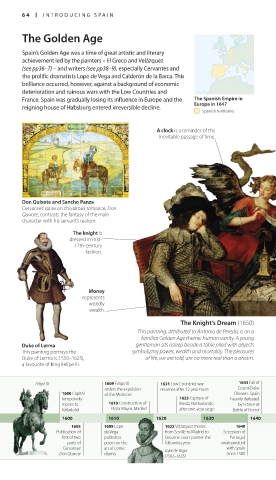
A clock is a reminder of the
inevitable passage of time.
Don Quixote and Sancho Panza
Cervantes’ satire on chivalrous romance, Don
Quixote, contrasts the fantasy of the main
character with his servant’s realism.
The knight is
dressed in mid-
17th-century
fashion.
Money
represents
worldly
wealth.
The Knight’s Dream (1650)
This painting, attributed to Antonio de Pereda, is on a
familiar Golden Age theme: human vanity. A young
Duke of Lerma gentleman sits asleep beside a table piled with objects
This painting portrays the symbolizing power, wealth and mortality. The pleasures
Duke of Lerma (c.1550–1625), of life, we are told, are no more real than a dream.
a favourite of King Felipe III.
Felipe III 1609 Felipe III 1621 Low Countries war 1643 Fall of
orders the expulsion resumes after 12-year truce Count-Duke
1600 Capital of the Moriscos Olivares. Spain
temporarily 1625 Capture of heavily defeated
moves to 1619 Construction of Breda, Netherlands, by France at
Valladolid Plaza Mayor, Madrid after one-year siege Battle of Rocroi
1600 1610 1620 1630 1640
1605 1609 Lope 1622 Velázquez moves 1640
Publication of de Vega from Seville to Madrid to Secession of
first of two publishes become court painter the Portugal,
parts of poem on the following year amalgamated
Cervantes’ art of comic Lope de Vega with Spain
Don Quixote drama since 1580
(1562–1635)
064-065_EW_Spain.indd 64 26/09/17 11:52 am

