


Page 12 - What Doctors Don't Tell You - AU-NZ (February-March 2020)
P. 12
UPFRONT
           UP FR O


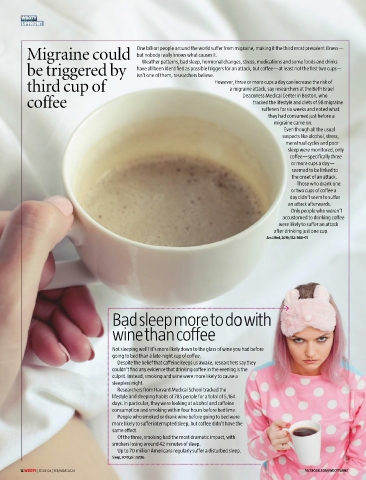
             Migraine could                                   One billion people around the world suffer from migraine, making it the third most prevalent illness—
                                                              but nobody really knows what causes it.
                                                                Weather patterns, bad sleep, hormonal changes, stress, medications and some foods and drinks
             be triggered by                                  have all been identified as possible triggers for an attack, but coffee—at least not the first two cups—
                                                              isn’t one of them, researchers believe.
             third cup of                                                                       However, three or more cups a day can increase the risk of
                                                                                                       a migraine attack, say researchers at the Beth Israel
             coffee                                                                                          Deaconess Medical Center in Boston, who
                                                                                                                 tracked the lifestyle and diets of 98 migraine
                                                                                                                     sufferers for six weeks and noted what
                                                                                                                        they had consumed just before a
                                                                                                                           migraine came on.
                                                                                                                               Even though all the usual
                                                                                                                              suspects like alcohol, stress,
                                                                                                                                menstrual cycles and poor
                                                                                                                                 sleep were monitored, only
                                                                                                                                  coffee—specifically three
                                                                                                                                  or more cups a day—
                                                                                                                                  seemed to be linked to
                                                                                                                                  the onset of an attack.
                                                                                                                                     Those who drank one
                                                                                                                                  or two cups of coffee a
                                                                                                                                  day didn’t seem to suffer
                                                                                                                                 an attack afterwards.
                                                                                                                                  Only people who weren’t
                                                                                                                              accustomed to drinking coffee
                                                                                                                             were likely to suffer an attack
                                                                                                                           after drinking just one cup.
                                                                                                                       Am J Med, 2019; 132: 984–91


                                                   Badsleepmoretodo


                                                   winethancoffee


                                                   Not sleeping well? It’s more likely down to the glass of wine you had before
                                                                                                         o
                                                   going to bed than a late-night cup of coffee.
                                                     Despite the belief that caffeine keeps us awake, researchers say they
                                                                                                         r
                                                   couldn’t find any evidence that drinking coffee in the evening is the
                                                   culprit. Instead, smoking and wine were more likely to cause aa
                                                   sleepless night.
                                                     Researchers from Harvard Medical School tracked the
                                                   lifestyle and sleeping habits of 785 people for a total of 5,164
                                                   days. In particular, they were looking at alcohol and caffeine
                                                   consumption and smoking within four hours before bedtime.
                                                     People who smoked or drank wine before going to bed were
                                                                                                          t
                                                   more likely to suffer interrupted sleep, but coffee didn’t have the
                                                   same effect.
                                                     Of the three, smoking had the most dramatic impact, with
                                                   smokers losing around 42 minutes of sleep.
                                                     Up to 70 million Americans regularly suffer a disturbed sleeep.
                                                   Sleep,2019;pii:zsz136


          12 WDDTY | ISSUE 04 | FEB/MAR 2020                                                                                            FACEBOOK.COM/WDDTYAUNZ

