


Page 16 - What Doctors Don't Tell You - AU-NZ (February-March 2020)
P. 16
UPFRONT
           UP FR O


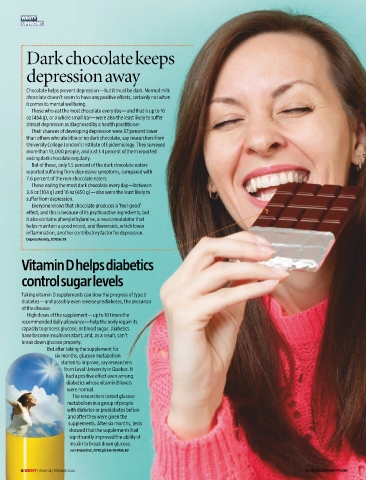
             Dark chocolate keeps


             depression away


             Chocolate helps prevent depression—but it must be dark. Normal milk
             chocolate doesn’t seem to have any positive effects, certainly not when
             it comes to mental wellbeing.
               Those who eat the most chocolate every day—and that is up to 16
             oz (454 g), or a whole small bar—were also the least likely to suffer
             clinical depression as diagnosed by a health practitioner.
               Their chances of developing depression were 57 percent lower
             than others who ate little or no dark chocolate, say researchers from
             University College London’s Institute of Epidemiology. They surveyed
             more than 13,000 people, and just 1.4 percent of them reported
             eating dark chocolate regularly.
               But of these, only 1.5 percent of the dark chocolate eaters
             reported suffering from depressive symptoms, compared with
             7.6 percent of the non-chocolate eaters.
               Those eating the most dark chocolate every day—between
             3.6 oz (104 g) and 16 oz (450 g)—also were the least likely to
             suffer from depression.
               Everyone knows that chocolate produces a ‘feel-good’
             effect, and this is because of its psychoactive ingredients, but
             it also contains phenylethylamine, a neuromodulator that
             helps maintain a good mood, and flavonoids, which lower
             inflammation, another contributory factor for depression.
             Depress Anxiety, 2019 Jul 29


           Vitamin D helps diabetics


           control sugar levels


           Taking vitamin D supplements can slow the progress of type 2
           diabetes—and possibly even reverse prediabetes, the precursor
           of the disease.
             High doses of the supplement—up to 10 times the
           recommended daily allowance—help the body regain its
                     pr
                  to
                ty
                                  e,
                       ocess
                            gl
               ci
                              ucos
             pa
           ca
           capacity to process glucose, or blood sugar. Diabetics
           have become insulin resista nt, and, as a result, can’t
           break down glucose proper ly.
                                   g the supplement for
                      But after taking
                         six months , glucose metabolism
                            started t to improve, say researchers
                             from L aval University in Quebec. It
                              had a  positive effect even among
                                   etics whose vitamin D levels
                               diabe
                               were  normal.
                                 Th e researchers tested glucose
                                   abolism in a group of people
                               meta
                               with  diabetes or prediabetes before
                                   after they were given the
                               and a
                               supp
                                   plements. After six months, tests
                                show
                                   wed that the supplements had
                                  nificantly improved the ability of
                                sign
                                insu
                                  ulin to break down glucose.
                                Eur J  Endocrinol, 2019; pii: EJE-19-0156.R2


          16 WDDTY | ISSUE 04 | FEB/MAR 2020                                                                                            FACEBOOK.COM/WDDTYAUNZ

