


Page 40 - All About History - Issue 70-18
P. 40
Wars of the Roses


                    by his 12-year-old son Edward V. As the     one of Richard’s supporters and was one of the
                   new king’s only surviving paternal uncle,    most powerful men in England. Richard’s military
                Richard believed he was vulnerable against      response was swift. In two weeks between October
             the machinations of the Woodville family and       and November 1483 he quashed the rebellion.
            took action to secure his position. He was named    Support for Buckingham failed to materialise and
           as Lord Protector of England during his nephew’s     Richard marched south to cut a wedge between the
          minority and personally intercepted the young king    duke in Wales and rebels in England.
          under armed escort en route to London.                   Buckingham’s army disintegrated and he was
             Richard lodged the king in the Tower of London,    captured and executed. Meanwhile, Henry had
          where he was joined by his nine-year-old brother.     sailed with a small fleet to Plymouth but some of his
          He then declared the boys to be illegitimate and was   ships were forced to return to France after a storm.
          crowned as Richard III on 6 July 1483. His nephews    Henry himself returned to France after he learned
          disappeared shortly afterwards in the tower, which    of Buckingham’s failure.
          was not surprising given that the citadel was            Richard was victorious but the rebellion was
          England’s most formidable fortress, and secrets       unsettling. A few hundred rebels escaped to France
          could be easily contained. The mysterious fate        and allied with Tudor while the revolt showed
          of the Princes in the Tower permanently stained       that there was a viable rival to the throne. It also
          Richard’s reputation, along with his usurpation of    showed that the king did not enjoy the total support
          Edward V’s crown.                                     of former Yorkists, which would have important
             Nevertheless, at his accession his military        consequences in the near future.
          position was very strong. Richard was not only king,
          but also England’s most preeminent general. His       Death at
          main Lancastrian opponent was Henry Tudor but         Bosworth                                       Over 30
          he was living in exile in Brittany.                   Richard ruled uneasily                   cannonshot were
             Despite this, rebels rose up in several English    throughout 1484 but on 7
          counties in Henry’s favour and the Duke of            August 1485 Henry landed in            found at Bosworth,
          Buckingham declared his support for them. This        Wales with a small invasion           more than any other                 responded quickly and raised
          was significant because Buckingham had been                                                     discovered on a
                                                                force of 2,000  men.  The king                                            8,000 men,   which he based
                                                                                                       European medieval                  at  Leicester.  Richard did not
                                                                                                              battlefield               want to delay in case Henry
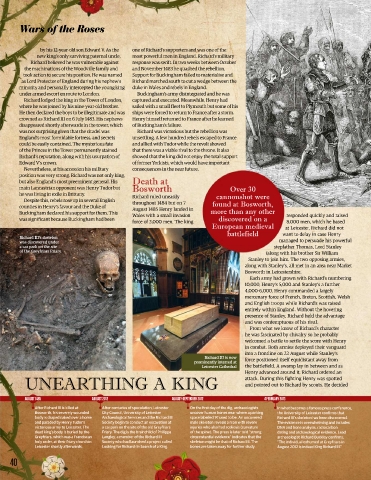
          Richard III’s skeleton
          was discovered under                                                                                                         managed to persuade his powerful
          a car park on the site                                                                                                    stepfather Thomas, Lord Stanley
          of the Greyfriars Friary                                                                                               (along with  his brother  Sir William

                                                                                                                        Stanley to join him. The two opposing armies,
                                                                                                                      along with Stanley’s, all met in an area near Market
                                                                                                                      Bosworth in Leicestershire.
                                                                                                                         Each army had grown with Richard’s numbering
                                                                                                                      10,000, Henry’s 5,000  and Stanley’s  a further
                                                                                                                      4,000-6,000. Henry commanded       a largely
                                                                                                                      mercenary force of French, Breton, Scottish, Welsh
                                                                                                                      and English troops while Richard’s was raised
                                                                                                                      entirely within England. Without the hovering
                                                                                                                      presence  of Stanley, Richard held  the advantage
                                                                                                                      and was contemptuous of his rival.
                                                                                                                         From what we know of Richard’s character
                                                                                                                      he was fascinated by chivalry so he probably
                                                                                                                      welcomed a battle to  settle the score with  Henry
                                                                                                                      in combat. Both armies deployed their vanguard
                                                                                                                      into a frontline on 22 August while Stanley’s
                                                                                                   Richard III is now   force positioned itself equidistant away from
                                                                                              prominently interred at
                                                                                                  Leicester Cathedral  the battlefield. A swamp lay in between and as
                                                                                                                      Henry advanced around it, Richard ordered an

             UNEARTHING                                                    A KING                                     attack. During this fighting Henry was spotted
                                                                                                                      and pointed out to
                                                                                                                                          Richard by scouts. He decided


             AUGUST1485                      AUGUST2012                            AUGUST SEPTEMBER2012                         4FEBRUARY2013
                  After Richard III is killed at   After centuries of speculation, Leicester   On the irst day of the dig, archaeologists   In what becomes a famous press conference,
                  Bosworth, his severely wounded   City Council, University of Leicester    uncover human bones near where a parking   the University of Leicester conirms that
                  body is draped naked over a horse   Archaeological Services and the Richard III   space labelled ‘R’ used to be. An uncovered   Richard III’s skeleton has been discovered.
                  and paraded by Henry Tudor’s    Society begin to conduct an excavation at   male skeleton reveals a man with severe   The evidence is overwhelming and includes
                  victorious army to Leicester. The   a car park on the site of the old Greyfriars   injuries who also had scoliosis (curvature   DNA and bone analysis, radiocarbon
                  dead king’s body is buried by the   Friary. The dig is the brainchild of Philippa   of the spine). The press is later told “strong   dating and archaeological evidence. Lead
                  Greyfriars, which was a Franciscan   Langley, a member of the Richard III  circumstantial evidence” indicates that the   archaeologist Richard Buckley conirms,
                  holy order, at their friary church in   Society who had launched a project called  sk skelet ton might be that of Richard III. The   “The individual exhumed at Greyfriars in
                                                                                                 are taken away for further study.
                  Leicester shortly afterwards.   Looking for Richard: In Search of a King.  bones a                                  August 2012 is indeed King Richard III.”

      40

