


Page 41 - All About History - Issue 70-18
P. 41
Ric ard III at War
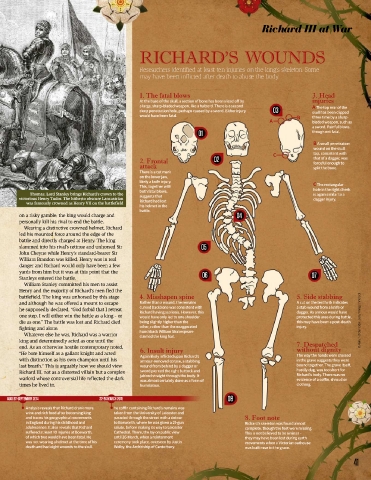
R D’S WOUNDS
Researchers dentified at l a t ten injuries o the king’s s eleton. Some
may have bee inflicted after death to abu e the body
1. The fatal blows 3. Head
At the base of the skull, a section of bone has been sliced of by injuries
a large, sharp-bladed weapon, like a halberd. There is a second A The top rear of the
deep penetration hole, perhaps caused by a sword. Either injury 03 skull has been clipped
would have been fatal. B three time by a sharp-
A bladed weapon, such as
a sword. Painful blows,
01 though not fatal.
B A small penetration
wound on the skull
C top, consistent with
2. Frontal 02 that of a dagger, was
forceful enough to
attack split the bone.
There is a cut mark
on the lower jaw,
likely a knife injury.
This, together with C The rectangular
hole in the right cheek
both fatal blows,
Thomas, Lord Stanley brings Richard’s crown to the is again similar to a
victorious Henry Tudor. The hithe to obscure Lancastrian suggests that dagger injury.
was famously crowned as Henry VII on the battlefield Richard had lost
his helmet in the
battle.
on a risky gamble: the king would charge and 04
personally kill his rival to end the battle.
Wearing a distinctive crowned helmet, Richard
led his mounted force around the edge of the
battle and directly charged at Henry. The king
slammed into his rival’s retinue and unhorsed Sir 05
John Cheyne while Henry’s standard-bearer Sir
William Brandon was killed. Henry was in real
danger and Richard would only have been a few
yards from him but it was at this point that the 06
Stanleys entered the battle. 07
William Stanley committed his men to assist
Henry and the majority of Richard’s men fled the
battlefield. The king was unhorsed by this stage 4. Misshapen spine 5. Side stabbing hinkstock
and although he was offered a mount to escape Rather than a wound, the remains A cut on the tenth rib indicates
he supposedly declared, “God forbid that I retreat curved backbone was consistent with a stab wound from a knife or
Richard having scoliosis. However, this dagger. As armour would have
one step. I will either win the battle as a king – or would have only led to one shoulder protected this area during battle,
die as one.” The battle was lost and Richard died being slightly higher than the this may have been a post-death
fighting and alone. other, rather than the exaggerated injury. © Alamy, Nicholas Forder, Joe Cummings,
hunchback William Shakespeare
Whatever else he was, Richard was a warrior
claimed the king had.
king and determinedly acted as one until the
end. As an otherwise hostile contemporary noted, 7. Despatched
without dignity
“He bore himself as a gallant knight and acted 6. Insult injury
Again likely inlicted upon Richard’s The way the hands were crossed
with distinction as his own champion until his armour-removed corpse, a stabbing in the grave suggests they were
last breath.” This is arguably how we should view wound from behind by a dagger or bound together. The grave itself,
Richard III, not as a distorted villain but a complex sword pierced the right buttock and hastily dug, was too short for
jabbed straight through the body. It Richard’s body. There was no
warlord whose controversial life reflected the dark was almost certainly done as a form of evidence of a coin, shroud or
times he lived in. humiliation. clothing.
AUGUST SEPTEMBER 2014 22 26 MARCH 2015 08
Analysis reveals that Richard drank more he coin containing Richard’s remains was
wine and rich food after becoming king taken from the University of Leicester and
and traces his geographical movements paraded through the street with a detour 8. Foot note
in England during his childhood and to Bosworth, where he was given a 21-gun Richard’s skeleton was found almost
adolescence. It also reveals that Richard salute, before making its way to Leicester complete though the feet were missing.
sufered at least 10 injuries at Bosworth, Cathedral. There, the lay on public view This is not believed to be sinister –
of which two would have been fatal. He until 26 March, when a reinterment they may have been lost during earth
was not wearing a helmet at the time of his ceremony took place, overseen by Justin movements when a Victorian outhouse
death and had eight wounds to the skull. Welby, the Archbiship of Canterbury. was built near to the grave.
41

