


Page 88 - All About History - Issue 70-18
P. 88
What if…


          Would the shogunate have been able to keep control?
          I think it would be tenuous. It would have emboldened the
          Western powers to get more involved. Even if the shogunate
          managed to hold on, I think it would mean that Japan would
          not have been so successful at modernisation.


          To what extent did the Restoration cause Japan to
          modernise and would the shogunate have resisted this?
          Both the shogunate and the Restoration forces recognised the
          need to modernise the military hardware. The question was
          how far you take some of these reforms.
             There is the famous phrase, ‘wakon-yōsai’, that means
          ‘Japanese spirit, Western learning’. That seems to have
          been implemented in a pragmatic way throughout the early
          stages of the Restoration. Especially in the first 10 years
          following Restoration, there’s a very complex process of
          negotiation, almost bit by bit, where people are trying to sort
          out how far you can adopt certain things from Western culture
          and still stay Japanese.
             I think there is a realisation after time that you could still
          cut your hair, wear Western clothes, and nonetheless pursue
          the original aims of preserving the integrity of the country.


          Could Japan still have won the 1904 Russo-Japanese
          war without Restoration’s widespread modernisation?
          Under the [shogunate], would they have been able to develop
          the military prowess to trouble the Russians? It’s possible.
          Russia was a fairly powerless state in terms of international
          situation and governance, and the shogunate did already
          have a record for developing a fairly strong naval presence.
          The more serious question that plays further along is what
          would have happened to Japanese relations with other
          Western powers. The Satsuma clan had a relationship with
          England that was very strong and certainly filtered into the
          development of the navy and commerce.
             The French influence probably would have stayed with the
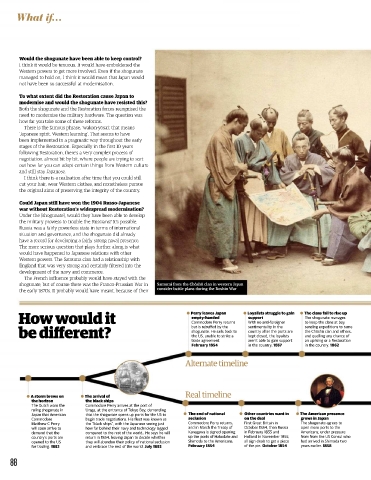
          shogunate, but of course there was the Franco-Prussian War in     Samurai from the Chōshū clan in western Japan
                                                                            consider battle plans during the Boshin War
          the early 1870s. It probably would have meant, because of their


          How would it                                                                     O Perry leaves Japan       O Loyalists struggle to gain  O The clans fail to rise up
                                                                                                                                                   The shogunate manages
                                                                                             empty-handed
                                                                                                                        support
                                                                                                                                                   to keep the clans at bay,
                                                                                                                        With no anti-foreigner
                                                                                             Commodore Perry returns
          be di erent?                                                                       but is rebuffed by the     sentimentality in the      sending expeditions to tame
                                                                                             shogunate. He sails back to
                                                                                                                        country after the ports are
                                                                                                                                                   the Chōshū clan and others,
                                                                                                                        kept closed, the loyalists
                                                                                             the US, unable to strike a
                                                                                             trade agreement.           aren’t able to gain support  and quelling any chance of
                                                                                                                                                   an uprising or a Restoration
                                                                                             February 1854              in the country. 1857       in the country. 1862
                                                                                          Alternate timeline


                                                                                          Realtimeline
              O A storm brews on        O The arrival of
                the horizon               the black ships
                The Dutch warn the        Commodore Perry arrives at the port of
                ruling shogunate in       Uraga, at the entrance of Tokyo Bay, demanding
                Japan that American       that the shogunate opens up ports for the US to   O The end of national   O Other countries want in  O The American presence
                Commodore                 begin trade negotiations. His fleet was known as   seclusion                on the deal                grows in Japan
                Matthew C Perry           the “black ships”, with the Japanese seeing just   Commodore Perry returns,  First Great Britain in    The shogunate agrees to
                will soon arrive to       how far behind their navy and technology lagged   and in March the Treaty of  October 1854, then Russia  open more ports to the
                demand that the           compared to the rest of the world.. He says he will   Kanagawa is signed opening  in February 1855 and  Americans, under pressure
                country’s ports are       return in 1854, leaving Japan to decide whether   up the ports of Hakodate and  Holland in November 1855,  from from the US Consul who
                opened to the US          they will abandon their policy of national seclusion   Shimoda to the Americans.  all sign deals to get a piece  had arrived in Shimoda two
                for trading. 1852         and embrace the rest of the world. July 1853     February 1854              of the pie. October 1854   years earlier. 1858


      88

