


Page 89 - All About History - Issue 70-18
P. 89
What if…

                                                                                                                            THE MEIJIRESTORATIONHADFAILED?


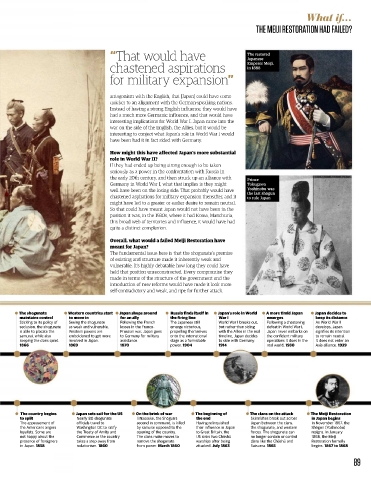
                                                      “That would have                                                  The restored
                                                                                                                        Japanese
                                                      chastened aspirations                                             Emperor Meiji,
                                                                                                                        in 1888
                                                      for military expansion”


                                                      antagonism with the English, that [Japan] could have come
                                                      quicker to an alignment with the German-speaking nations.
                                                      Instead of having a strong English influence, they would have
                                                      had a much more Germanic influence, and that would have
                                                      interesting implications for World War I. Japan came into the
                                                      war on the side of the English, the Allies, but it would be
                                                      interesting to conject what Japan’s role in World War I would
                                                      have been had it in fact sided with Germany.


                                                      How might this have affected Japan’s more substantial
                                                      role in World War II?
                                                      If they had ended up being strong enough to be taken
                                                      seriously as a power in the confrontation with Russia in
                                                      the early 20th century, and then struck up an alliance with       Prince
                                                      Germany in World War I, what that implies is they might           Tokugawa
                                                                                                                        Yoshinobu was
                                                      well have been on the losing side. That probably would have
                                                                                                                        the last shōgun
                                                      chastened aspirations for military expansion thereafter, and it   to rule Japan
                                                      might have led to a greater or earlier desire to remain neutral.
                                                      So that could have meant Japan would not have been in the
                                                      position it was, in the 1930s, where it had Korea, Manchuria,
                                                      this broad web of territories and influence, it would have had
                                                      quite a distinct complexion.

                                                      Overall, what would a failed Meiji Restoration have
                                                      meant for Japan?
                                                      The fundamental issue here is that the shogunate’s premise
                                                      of existing and structure made it inherently weak and
                                                      vulnerable. It’s highly debatable how long they could have
                                                      held that position unreconstructed. Every compromise they
                                                      made in terms of the structure of the government and the
                                                      introduction of new reforms would have made it look more
                                                      self-contradictory and weak, and ripe for further attack.


        O The shogunate         O Western countries start O Japan shops around  O Russia finds itself in  O Japan’s role in World  O A more timid Japan   O Japan decides to
          maintains control       to move in               for an ally             the firing line        War I                  emerges                keep its distance
          Sticking to its policy of   Seeing the shogunate  Following the French   The Japanese still     World War I breaks  out,  Following a chastening  As World War II
          seclusion, the shogunate   as weak and vulnerable,  losses in the Franco-  emerge victorious,   but rather than siding  defeat in World War I,  develops, Japan
          is able to placate the   Western powers are      Prussian war, Japan goes  propelling themselves  with the Allies in the real  Japan never embarks on  signifies its intention
          samurai, while also     emboldened to get more   to Germany for military  onto the international  timeline, Japan decides  the confident military  to remain neutral.
          keeping the clans quiet.   involved in Japan.    assistance.             stage as a formidable  to side with Germany.  operations it does in the  It does not enter an
          1866                    1869                     1870                    power. 1904            1914                   real world. 1930       Axis alliance. 1939


        O  The country begins      O Japan sets sail for the US  O On the brink of war       O The beginning of        O The clans on the attack    O The Meiji Restoration
           to split                   Nearly 80 shogunate          li Naosuke, the Shōgun’s    the end                   Skirmishes break out across   in Japan begins
           The appeasement of         officials travel to          second in command, is killed  Having relinquished     Japan between the clans,     In November 1867, the
           the Americans angers       Washington DC to ratify      by samurai opposed to the   their influence in Japan  the shogunate, and western   Shōgun (Yoshinobu)
           loyalists. Some are        the Treaty of Amity and      opening of the country.     to Great Britain, the     forces. The shogunate can    resigns. In January
           not happy about the        Commerce as the country      The clans make moves to     US sinks two Chōshū       no longer contain or control   1868, the Meiji
           presence of foreigners     takes a step away from       remove the shogunate        warships after being      clans like the Chōshū and    Restoration formally
           in Japan. 1858             isolationism. 1860           from power. March 1860      attacked. July 1863       Satsuma. 1865                begins. 1867 to 1868


                                                                                                                                                                           89

