


Page 57 - Dog
P. 57
THE ELEGANT “COACH DOG”
                                                                                           In the 1800s, it was very fashionable
                                                                                              in England and France to have a
                         JUMPING THROUGH HOOPS
                            Because the poodle is one of the                                    “coach dog” to accompany the
                             most easily trained of breeds, it has                                carriages of aristocrats. The
                              been commonly used as a circus                                           horses’ harness and
                              dog. In this fine gold brooch, made                                        dog’s coat colors
                              in Austria c.1890, a clown encourages                                     were coordinated.
                              his troop of dogs to perform tricks.


        Muzzle is
        adorned by
        a massive
        mustache


        This strongest                    BUSHY-HAIRED BEAUTY
        of all the                     Schnauzers got their name from
        schnauzers                       the German word Schnauze,
        – the giant                    meaning “muzzle.” Originally used
        schnauzer –                     for herding sheep in southern
        stands up to                     Germany, nowadays these
        2 ft (65 cm) at                 energetic dogs make excellent
        the shoulder                    companions and family pets. In
                                       the U.S. and Canada the giant and
                                       standard schnauzers are classified
                                       as working dogs (pp. 56–57), and
                                         the miniature is in the terrier
                                            group (pp. 52–53).


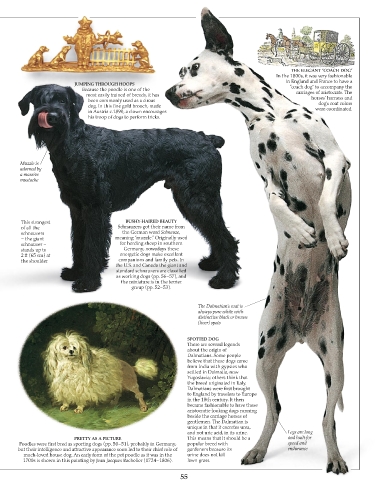
                                                                  The Dalmatian’s coat is
                                                                  always pure white with
                                                                  distinctive black or brown
                                                                  (liver) spots


                                                              SPOTTED DOG
                                                              There are several legends
                                                              about the origin of
                                                              Dalmatians. Some people
                                                              believe that these dogs came
                                                              from India with gypsies who
                                                              settled in Dalmatia, now
                                                              Yugoslavia; others think that
                                                              the breed originated in Italy.
                                                              Dalmatians were first brought
                                                              to England by travelers to Europe
                                                              in the 18th century. It then
                                                              became fashionable to have these
                                                              aristocratic-looking dogs running
                                                              beside the carriage horses of
                                                              gentlemen. The Dalmatian is
                                                              unique in that it excretes urea,
                                                              and not uric acid, in its urine.   Legs are long
                         PRETTY AS A PICTURE                  This means that it should be a   and built for
       Poodles were first bred as sporting dogs (pp. 50–51), probably in Germany,   popular breed with   speed and
       but their intelligence and attractive appearance soon led to their chief role of   gardeners because its   endurance
         much-loved house dog. An early form of the pet poodle as it was in the   urine does not kill
         1700s is shown in this painting by Jean Jacques Bachelier (1724–1806).   lawn grass.

                                                            55
                                            (c) 2011 Dorling Kindersley. All Rights Reserved.

