


Page 56 - Dog
P. 56
Nonsporting dogs                                                      The Boston terrier is
                                                                                                         MADE IN AMERICA
                                                                                                        a very popular dog
                                                                                                         and is one of the
                                                                                                          few breeds to have
                                  Nonsporting dogs is a miscellaneous                                      been developed
                                                                                                           in the U.S.
                                  collection of dogs that includes the ones left over
                                  after all the other breeds have been neatly
                                  categorized into the other five groups (pp. 48–53,
                                      56–59). The title of “special dogs” might be more apt to
                                      describe the range of individual, and special, characteristics, as this
                                      group includes some of the more unusual dogs. The history of some
                                      nonsporting dogs goes back for many centuries – the forerunner of
                                      the chow chow was first bred 3,000 years ago in Mongolia, Asia, for

               USEFUL HELPERS         use in war, and later, in China, as a source of fur and food. In fact, most
         In this detail from a 17th-century   of the dogs in this group were originally bred for work or sport but are
          Japanese screen, a richly dressed
          Portuguese merchant is shown   now kept primarily as pets and show dogs. For example, at one time
           with his servants and faithful
             companion – his dog.     French hunters sent poodles to retrieve ducks; bulldogs were once bred
                                      for baiting bulls (pp. 46–47); and Dalmatians were used for herding
                                      cattle and hunting game. This group also includes national dogs from
             The back has retained the
             powerful muscles of the            various countries – the Boston terrier from the United States,
             old-fashioned bulldog                  the bulldog from Britain, and the poodle from France.


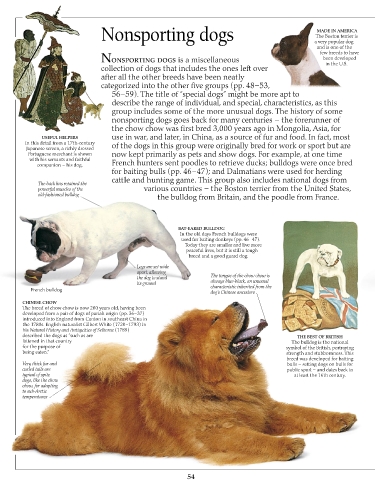
                                                           BAT-EARED BULLDOG
                                                            In the old days French bulldogs were
                                                            used for baiting donkeys (pp. 46–47).
                                                             Today they are smaller and live more
                                                              peaceful lives, but it is still a tough
                                                               breed and a good guard dog.
                                              Legs are set wide
                                              apart, allowing
                                              the dog to stand        The tongue of the chow chow is
                                              its ground              always blue-black, an unusual
           French bulldog                                             characteristic inherited from the
                                                                      dog’s Chinese ancestors
        CHINESE CHOW
        The breed of chow chow is now 200 years old, having been
        developed from a pair of dogs of pariah origin (pp. 36–37)
        introduced into England from Canton in southeast China in
        the 1780s. English naturalist Gilbert White (1720–1793) in
        his Natural History and Antiquities of Selborne (1789)
        described the dogs as “such as are                                                        THE BEST OF BRITISH
        fattened in that country                                                                The bulldog is the national
        for the purpose of                                                                    symbol of the British, portraying
        being eaten.”                                                                          strength and stubbornness. This
                                                                                               breed was developed for baiting
        Very thick fur and                                                                     bulls – setting dogs on bulls for
        curled tails are                                                                       public sport – and dates back to
        typical of spitz                                                                         at least the 16th century.
        dogs, like the chow
        chow, for adapting
        to sub-Arctic
        temperatures


                                                              54
                                            (c) 2011 Dorling Kindersley. All Rights Reserved.

