


Page 58 - Dog
P. 58
Working dogs


                               The earliest domestic dogs (pp. 34–35) were
                               companions to human hunters in their pursuit of all
                               sorts of animals from mammoths to small birds.
                               Over the thousands of years since that time, dogs
                               have always worked with people. Before Europeans
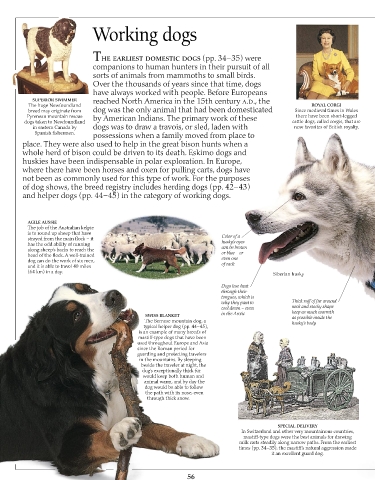
            SUPERIOR SWIMMER   reached North America in the 15th century a.d., the
          The huge Newfoundland                                                                        ROYAL CORGI
          breed may originate from   dog was the only animal that had been domesticated          Since medieval times in Wales
          Pyrenean mountain rescue   by American Indians. The primary work of these               there have been short-legged
         dogs taken to Newfoundland                                                             cattle dogs, called corgis, that are
            in eastern Canada by   dogs was to draw a travois, or sled, laden with               now favorites of British royalty.
            Spanish fishermen.  possessions when a family moved from place to
        place. They were also used to help in the great bison hunts when a
        whole herd of bison could be driven to its death. Eskimo dogs and
        huskies have been indispensable in polar exploration. In Europe,
        where there have been horses and oxen for pulling carts, dogs have
        not been as commonly used for this type of work. For the purposes
        of dog shows, the breed registry includes herding dogs (pp. 42–43)
        and helper dogs (pp. 44–45) in the category of working dogs.


          AGILE AUSSIE
          The job of the Australian kelpie
          is to round up sheep that have
          strayed from the main flock – it                               Color of a
          has the odd ability of running                                 husky’s eyes
          along sheep’s backs to reach the                               can be brown
          head of the flock. A well-trained                              or blue – or
          dog can do the work of six men,                                even one
          and it is able to travel 40 miles                              of each
          (64 km) in a day.                                                               Siberian husky

                                                                         Dogs lose heat
                                                                         through their
                                                                         tongues, which is
                                                                         why they pant to       Thick ruff of fur around
                                                                         cool down – even       neck and stocky shape
                                                                         in the Arctic          keep as much warmth
                                                SWISS BLANKET                                   as possible inside the
                                                The Bernese mountain dog, a                     husky’s body
                                                typical helper dog (pp. 44–45),
                                              is an example of many breeds of
                                              mastiff-type dogs that have been
                                              used throughout Europe and Asia
                                              since the Roman period for
                                              guarding and protecting travelers
                                              in the mountains. By sleeping
                                               beside the traveler at night, the
                                               dog’s exceptionally thick fur
                                                would keep both human and
                                                animal warm, and by day the
                                                dog would be able to follow
                                                the path with its nose, even
                                                 through thick snow.


                                                                                            SPECIAL DELIVERY
                                                                                In Switzerland and other very mountainous countries,
                                                                                 mastiff-type dogs were the best animals for drawing
                                                                               milk carts steadily along narrow paths. From the earliest
                                                                               times (pp. 34–35), the mastiff’s natural aggression made
                                                                                          it an excellent guard dog.


                                                              5
                                            (c) 2011 Dorling Kindersley. All Rights Reserved.

