


Page 8 - Dog
P. 8
What is a dog?


                                     The dog family, called Canidae from the
                                     Latin canis meaning “dog,” includes
                                     approximately 37 species of wolves, jackals,
                                     foxes, and wild and domestic dogs. All members
                                     of the dog family, or canids, are carnivores
                                     (meat eaters) and have special adaptations for
                                     hunting. Their teeth (pp. 8–9) are used for
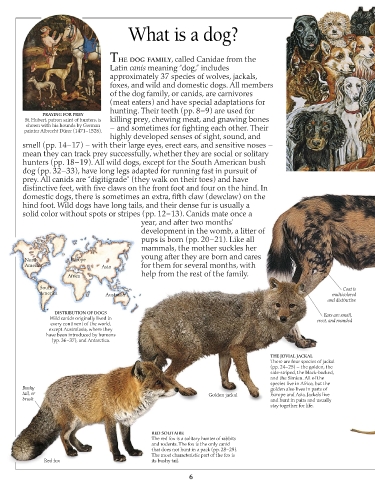
               PRAYING FOR PREY
         St. Hubert, patron saint of hunters, is   killing prey, chewing meat, and gnawing bones
          shown with his hounds by German   – and sometimes for fighting each other. Their
         painter Albrecht Dürer (1471–1528).
                                     highly developed senses of sight, sound, and
        smell (pp. 14–17) – with their large eyes, erect ears, and sensitive noses –
        mean they can track prey successfully, whether they are social or solitary
        hunters (pp. 18–19). All wild dogs, except for the South American bush
        dog (pp. 32–33), have long legs adapted for running fast in pursuit of
        prey. All canids are “digitigrade” (they walk on their toes) and have
        distinctive feet, with five claws on the front foot and four on the hind. In
        domestic dogs, there is sometimes an extra, fifth claw (dewclaw) on the
        hind foot. Wild dogs have long tails, and their dense fur is usually a
        solid color without spots or stripes (pp. 12–13). Canids mate once a
                                               year, and after two months’
                                               development in the womb, a litter of
                                               pups is born (pp. 20–21). Like all
                                               mammals, the mother suckles her
                                               young after they are born and cares
         North          Europe
         America                  Asia         for them for several months, with
                       Africa                  help from the rest of the family.
              South                                                                                              Coat is
              America              Australia                                                                  multicolored
                                                                                                            and distinctive
                   DISTRIBUTION OF DOGS                                                                    Ears are small,
                 Wild canids originally lived in                                                         erect, and rounded
                 every continent of the world,
                 except Australasia, where they
                have been introduced by humans
                  (pp. 36–37), and Antarctica.

                                                                                         THE JOVIAL JACKAL
                                                                                         There are four species of jackal
                                                                                         (pp. 24–25) – the golden, the
                                                                                         side-striped, the black-backed,
                                                                                         and the Simien. All of the
                                                                                         species live in Africa, but the
        Bushy                                                                            golden also lives in parts of
        tail, or                                                     Golden jackal       Europe and Asia. Jackals live
        brush                                                                            and hunt in pairs and usually
                                                                                         stay together for life.


                                                   RED SOLITAIRE
                                                   The red fox is a solitary hunter of rabbits
                                                   and rodents. The fox is the only canid
                                                   that does not hunt in a pack (pp. 28–29).
                                                   The most characteristic part of the fox is
               Red fox                             its bushy tail.


                                            (c) 2011 Dorling Kindersley. All Rights Reserved.

