


Page 11 - Dog
P. 11
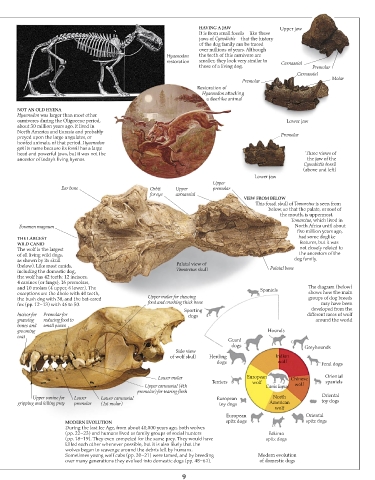
HAVING A JAW              Upper jaw
                                                                  It is from small fossils – like these
                                                                  jaws of Cynodictis – that the history
                                                                  of the dog family can be traced
                                                                  over millions of years. Although
                                                       Hyaenodon   the teeth of this carnivore are
                                                       restoration  smaller, they look very similar to   Carnassial
                                                                  those of a living dog.               Premolar
                                                                                                  Carnassial
                                                                                Premolar                     Molar
                                                                 Restoration of
                                                                   Hyaenodon attacking
                                                                    a deerlike animal
       NOT AN OLD HYENA
       Hyaenodon was larger than most other
       carnivores during the Oligocene period,                                                 Lower jaw
       about 30 million years ago. It lived in
       North America and Eurasia and probably
       preyed upon the large ungulates, or                                                   Premolar
       hoofed animals, of that period. Hyaenodon
       got its name because its fossil has a large
       head and powerful jaws, but it was not the                                                    Three views of
       ancestor of today’s living hyenas.                                                            the jaw of the
                                                                                                    Cynodictis fossil
                                                                                                    (above and left)
                                                                                    Lower jaw
                                                                       Upper
                     Ear bone                     Orbit   Upper        premolar
                                                  for eye  carnassial
                                                                                 VIEW FROM BELOW
                                                                                    This fossil skull of Tomarctus is seen from
                                                                                         below, so that the palate, or roof of
                                                                                            the mouth, is uppermost.
                                                                                                Tomarctus, which lived in
       Foramen magnum                                                                            North Africa until about
                                                                                                  five million years ago,
       THE LARGEST                                                                                had some doglike
       WILD CANID                                                                                  features, but it was
       The wolf is the largest                                                                     not closely related to
       of all living wild dogs,                                                                    the ancestors of the
       as shown by its skull                                                                     dog family.
       (below). Like most canids,                          Palatal view of               Palatal bone
       including the domestic dog,                         Tomarctus skull
       the wolf has 42 teeth: 12 incisors,
       4 canines (or fangs), 16 premolars,
       and 10 molars (4 upper, 6 lower). The                                          Spaniels        The diagram (below)
       exceptions are the dhole with 40 teeth,                                                        shows how the main
       the bush dog with 38, and the bat-eared   Upper molar for chewing                              groups of dog breeds
       fox (pp. 12–13) with 46 to 50.            food and crushing thick bone                             may have been
                                                             Sporting                                  developed from the
       Incisor for   Premolar for                             dogs                                   different races of wolf
       gnawing   reducing food to                                                                       around the world
       bones and   small pieces
       grooming                                                                         Hounds
       coat
                                                                            Guard
                                                                             dogs                   Greyhounds
                                                          Side view
                                                         of wolf skull  Herding            Indian
                                                                        dogs                wolf          Feral dogs

                                                     Lower molar                  European      Chinese    Oriental
                                                                      Terriers     wolf                    spaniels
                                                Upper carnassial (4th                   Canis lupus  wolf
                                              premolar) for tearing flesh
            Upper canine for   Lower   Lower carnassial                 European          North           Oriental
       gripping and killing prey  premolar  (1st molar)                  toy dogs        American         toy dogs
                                                                                           wolf
                                                                           European                  Oriental
                      MODERN EVOLUTION                                     spitz dogs                spitz dogs
                      During the last Ice Age, from about 40,000 years ago, both wolves
                      (pp. 22–23) and humans lived as family groups of social hunters    Eskimo
                      (pp. 18–19). They even competed for the same prey. They would have   spitz dogs
                      killed each other whenever possible, but it is also likely that the
                      wolves began to scavenge around the debris left by humans.
                      Sometimes young wolf cubs (pp. 20–21) were tamed, and by breeding   Modern evolution
                      over many generations they evolved into domestic dogs (pp. 48–61).  of domestic dogs


                                            (c) 2011 Dorling Kindersley. All Rights Reserved.

