


Page 169 - (DK) Smithsinian - Military History: The Definitive Visual Guide to the Objects of Warfare
P. 169
167


                                                                                                Blade decorated
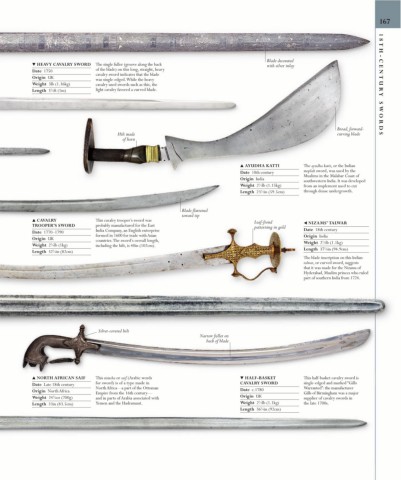
            ▼ HEAVY CAVALRY SWORD  The single fuller (groove along the back                     with silver inlay                       18TH-CENTUR
            Date  1750             of the blade) on this long, straight, heavy
                                   cavalry sword indicates that the blade
            Origin  UK
                                   was single-edged. While the heavy
            Weight  3lb (1.36kg)   cavalry used swords such as this, the
            Length  3 ⁄4ft (1m)    light cavalry favored a curved blade.                                                                Y SW
                   1


                                                                                                                         Broad, forward-  ORDS
                                           Hilt made                                                                     curving blade
                                             of horn


                                                                                       ▲ AYUDHA KATTI        The ayudha katti, or the Indian
                                                                                       Date  18th century    moplah sword, was used by the
                                                                                                             Muslims in the Malabar Coast of
                                                                                       Origin  India         southwestern India. It was developed
                                                                                             1
                                                                                       Weight  2 ⁄2lb (1.15kg)  from an implement used to cut
                                                                                              1
                                                                                       Length  23 ⁄2in (59.5cm)  through dense undergrowth.
                                                                  Blade flattened
                                                                  toward tip
            ▲ CAVALRY              This cavalry trooper’s sword was                         Leaf-frond
            TROOPER’S SWORD        probably manufactured for the East                       patterning in gold  ◀ NIZAMS’  TALWAR
            Date  1770–1790        India Company, an English enterprise                                      Date  18th century
                                   formed in 1600 for trade with Asian                                       Origin  India
            Origin  UK
                                   countries. The sword’s overall length,                                    Weight  2 ⁄2lb (1.1kg)
                                                                                                                    1
                   1
            Weight  2 ⁄4lb (1kg)   including the hilt, is 40in (102cm).
                                                                                                                     1
            Length  32 ⁄4in (82cm)                                                                           Length  37 ⁄4in (94.9cm)
                    1
                                                                                                             The blade inscription on this Indian
                                                                                                             talwar, or curved sword, suggests
                                                                                                             that it was made for the Nizams of
                                                                                                             Hyderabad, Muslim princes who ruled
                                                                                                             part of southern India from 1724.


                                    Silver-covered hilt
                                                                        Narrow fuller on
                                                                           back of blade


            ▲ NORTH AFRICAN SAIF   This nimcha or saif (Arabic words                   ▼ HALF-BASKET         This half-basket cavalry sword is
            Date  Late 18th century  for sword) is of a type made in                   CAVALRY SWORD         single-edged and marked “Gills
                                   North Africa—a part of the Ottoman                                        Warranted”: the manufacturer
            Origin  North Africa   Empire from the 16th century—                       Date  c.1780          Gills of Birmingham was a major
                    3
            Weight  24 ⁄4oz (700g)  and in parts of Arabia associated with             Origin  UK            supplier of cavalry swords in
                                                                                             1
            Length  33in (83.5cm)  Yemen and the Hadramaut.                            Weight  2 ⁄2lb (1.1kg)  the late 1700s.
                                                                                              1
                                                                                       Length  36 ⁄4in (92cm)

