


Page 170 - (DK) Smithsinian - Military History: The Definitive Visual Guide to the Objects of Warfare
P. 170
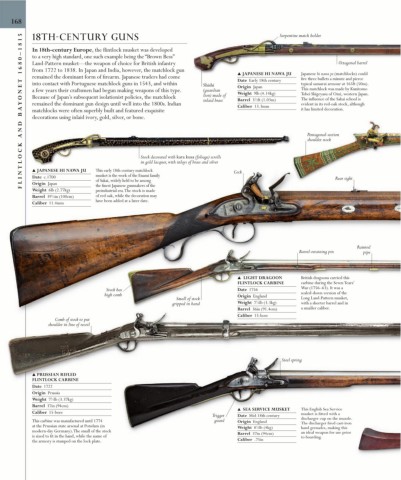
168    18TH-CENTURY GUNS                                                                        Serpentine match holder

         ONET 1680–1815  In 18th-century Europe, the flintlock musket was developed   Shishi   ▲ JAPANESE HI NAWA JU  Japanese hi nawa ju (matchlocks) could


            to a very high standard, one such example being the “Brown Bess”
            Land-Pattern musket—the weapon of choice for British infantry
                                                                                                                          Octagonal barrel
            from 1722 to 1838. In Japan and India, however, the matchlock gun
            remained the dominant form of firearm. Japanese traders had come
                                                                                                            fire three bullets a minute and pierce
                                                                                      Date  Early 18th century
            into contact with Portuguese matchlock guns in 1543, and within
                                                                                                            typical samurai armour at 165ft (50m).
                                                                                      Weight  9lb (4.14kg)
                                                                                                            Tobei Shigeyasu of Omi, western Japan.
                                                                         lion) made of
            Because of Japan’s subsequent isolationist policies, the matchlock
                                                                                                            The influence of the Sakai school is
                                                                                            1
                                                                                      Barrel  3 ⁄2ft (1.03m)
                                                                         inlaid brass
            remained the dominant gun design until well into the 1800s. Indian
         Y  a few years their craftsmen had begun making weapons of this type.   (guardian   Origin  Japan  This matchlock was made by Kunitomo
                                                                                                            evident in its red-oak stock, although
                                                                                      Caliber  13.3mm
                                                                                                            it has limited decoration.
         AND BA  decorations using inlaid ivory, gold, silver, or bone.                                        Pentagonal-section
            matchlocks were often superbly built and featured exquisite
                                                                                                               shoulder stock
         FLINTLOCK   ▲ JAPANESE HI NAWA JU  This early 18th-century matchlock       Cock
                                                   Stock decorated with kara kusa (foliage) scrolls
                                                   in gold lacquer, with inlays of brass and silver
                                   musket is the work of the Enami family
            Date  c.1700
            Origin  Japan
                                   the finest Japanese gunmakers of the
            Weight  6lb (2.77kg)   of Sakai, widely held to be among                                                    Rear sight
                                   preindustrial era. The stock is made
            Barrel  39 ⁄4in (100cm)  of red oak, while the decoration may
                   1
                                   have been added at a later date.
            Caliber  11.4mm


                                                                                                                                Ramrod
                                                                                                            Barrel-retaining pin   pipe


                                                                                      ▲  LIGHT DRAGOON      British dragoons carried this
                                                                                      FLINTLOCK CARBINE     carbine during the Seven  Years’
                                       Stock has                                      Date  1756            War (1756–63). It was a
                                      high comb                                       Origin  England       scaled-down version of the
                                                                Small of stock                              Long Land-Pattern musket,
                                                                                            1
                                                              gripped in hand         Weight  7 ⁄4lb (3.3kg)  with a shorter barrel and in
                                                                                      Barrel  36in (91.4cm)  a smaller caliber.
                                                                                      Caliber  15-bore
                    Comb of stock to put
                  shoulder in line of recoil


                                                                                                     Steel spring

            ▲ PRUSSIAN RIFLED
            FLINTLOCK CARBINE
            Date  1722
            Origin  Prussia
            Weight  7 ⁄2lb (3.37kg)
                   1
            Barrel  37in (94cm)
                                                                                      ▲  SEA SERVICE MUSKET  This English Sea Service
            Caliber  15-bore                                                                                musket is fitted with a
                                                                             Trigger   Date  Mid-18th century
                                                                                                            discharger cup on the muzzle.
            This carbine was manufactured until 1774                         guard    Origin  England       The discharger fired cast-iron
            at the Prussian state arsenal at Potsdam (in                              Weight  8 ⁄4lb (4kg)  hand grenades, making this
                                                                                            3
            modern-day Germany). The small of the stock                               Barrel  37in (94cm)   an ideal weapon for use prior
            is sized to fit in the hand, while the name of                                                  to boarding.
            the armory is stamped on the lock plate.                                  Caliber  .75in

