


Page 172 - (DK) Smithsinian - Military History: The Definitive Visual Guide to the Objects of Warfare
P. 172
170    FLINTLOCK MUSKETS AND BAYONETS

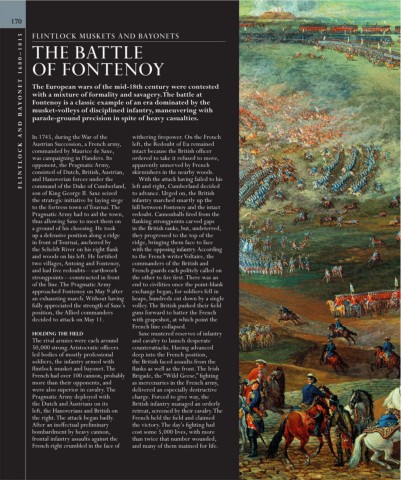
         ONET 1680–1815  THE BATTLE


            OF FONTENOY


            with a mixture of formality and savagery. The battle at
            Fontenoy is a classic example of an era dominated by the
         Y  The European wars of the mid-18th century were contested
         AND BA  parade-ground precision in spite of heavy casualties.
            musket-volleys of disciplined infantry, maneuvering with


                                                withering firepower. On the French
            In 1745, during the War of the
         FLINTLOCK   commanded by Maurice de Saxe,    intact because the British officer
                                                left, the Redoubt of Eu remained
            Austrian Succession, a French army,
            was campaigning in Flanders. Its
                                                ordered to take it refused to move,
            opponent, the Pragmatic Army,
                                                apparently unnerved by French
            consisted of Dutch, British, Austrian,  skirmishers in the nearby woods.
                                                  With the attack having failed to his
            and Hanoverian forces under the
            command of the Duke of Cumberland,  left and right, Cumberland decided
            son of King George II. Saxe seized   to advance. Urged on, the British
            the strategic initiative by laying siege   infantry marched smartly up the
            to the fortress town of Tournai. The   hill between Fontenoy and the intact
            Pragmatic Army had to aid the town,   redoubt. Cannonballs fired from the
            thus allowing Saxe to meet them on    flanking strongpoints carved gaps
            a ground of his choosing. He took    in the British ranks, but, undeterred,
            up a defensive position along a ridge   they progressed to the top of the
            in front of Tournai, anchored by    ridge, bringing them face to face
            the Scheldt River on his right flank   with the opposing infantry. According
            and woods on his left. He fortified   to the French writer Voltaire, the
            two villages, Antoing and Fontenoy,   commanders of the British and
            and had five redoubts—earthwork     French guards each politely called on
            strongpoints—constructed in front   the other to fire first. There was an
            of the line. The Pragmatic Army     end to civilities once the point-blank
            approached Fontenoy on May 9 after   exchange began, for soldiers fell in
            an exhausting march. Without having  heaps, hundreds cut down by a single
            fully appreciated the strength of Saxe’s  volley. The British pushed their field
            position, the Allied commanders     guns forward to batter the French
            decided to attack on May 11.        with grapeshot, at which point the
                                                French line collapsed.
            HOLDING THE FIELD                     Saxe mustered reserves of infantry
            The rival armies were each around   and cavalry to launch desperate
            50,000 strong. Aristocratic officers   counterattacks. Having advanced
            led bodies of mostly professional   deep into the French position,
            soldiers, the infantry armed with   the British faced assaults from the
            flintlock musket and bayonet. The   flanks as well as the front. The Irish
            French had over 100 cannon, probably  Brigade, the “Wild Geese,” fighting
            more than their opponents, and      as mercenaries in the French army,
            were also superior in cavalry. The   delivered an especially destructive
            Pragmatic Army deployed with        charge. Forced to give way, the
            the Dutch and Austrians on its      British infantry managed an orderly
            left, the Hanoverians and British on   retreat, screened by their cavalry. The
            the right. The attack began badly.   French held the field and claimed
            After an ineffectual preliminary    the victory. The day’s fighting had
            bombardment by heavy cannon,        cost some 5,000 lives, with more
            frontal infantry assaults against the   than twice that number wounded,
            French right crumbled in the face of   and many of them maimed for life.

