


Page 230 - (DK) Smithsinian - Military History: The Definitive Visual Guide to the Objects of Warfare
P. 230
228

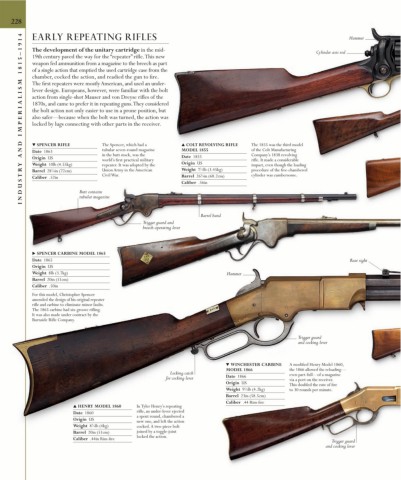
            EARLY REPEATING RIFLES                                                                                            Hammer
         AND IMPERIALISM 1815–1914
            The development of the unitary cartridge in the mid-                                                  Cylinder axis rod
            19th century paved the way for the “repeater” rifle. This new
            weapon fed ammunition from a magazine to the breech as part
            of a single action that emptied the used cartridge case from the
            chamber, cocked the action, and readied the gun to fire.
            The first repeaters were mostly American, and used an under-
            lever design. Europeans, however, were familiar with the bolt
            action from single-shot Mauser and von Dreyse rifles of the
            1870s, and came to prefer it in repeating guns. They considered
            the bolt action not only easier to use in a prone position, but
            also safer—because when the bolt was turned, the action was
            locked by lugs connecting with other parts in the receiver.


            ▼ SPENCER RIFLE          The Spencer, which had a     ▲ COLT REVOLVING RIFLE   The 1855 was the third model
            Date  1863               tubular seven-round magazine    MODEL 1855            of the Colt Manufacturing
                                     in the butt stock, was the                            Company’s 1838 revolving
            Origin  US               world’s first practical military   Date  1855         rifle. It made a considerable
         Y   Weight  10lb (4.55kg)   repeater. It was adopted by the   Origin  US 1        impact, even though the loading
                                                                  Weight  7 ⁄2lb (3.45kg)
                                                                                           procedure of the five-chambered
                                     Union Army in the American
         INDUSTR  Caliber  .52in  Butt contains                   Barrel  26 ⁄4in (68.2cm)  cylinder was cumbersome.
                   1
            Barrel  28 ⁄4in (72cm)
                                     Civil War.
                                                                         3
                                                                  Caliber  .56in
                             tubular magazine
                                                                        Barrel band
                                                    Trigger guard and
                                                    breech-operating lever


            ▶ SPENCER CARBINE MODEL 1865
            Date  1865                                                                                                        Rear sight
            Origin  US
            Weight  8lb (3.7kg)                                                   Hammer
            Barrel  20in (51cm)
            Caliber  .50in
            For this model, Christopher Spencer
            amended the design of his original repeater
            rifle and carbine to eliminate minor faults.
            The 1865 carbine had six-groove rifling.
            It was also made under contract by the
            Burnside Rifle Company.


                                                                                                           Trigger guard
                                                                                                           and cocking lever


                                                                                  ▼ WINCHESTER CARBINE   A modified Henry Model 1860,
                                                                                  MODEL 1866            the 1866 allowed the reloading—
                                                              Locking catch                             even part-full—of a magazine
                                                            for cocking lever     Date  1866            via a port on the receiver.
                                                                                  Origin  US
                                                                                                        This doubled the rate of fire
                                                                                        1
                                                                                  Weight  9 ⁄4lb (4.2kg)  to 30 rounds per minute.
                                                                                  Barrel  23in (58.5cm)
                                                                                  Caliber  .44 Rim-fire
                           ▲ HENRY MODEL 1860     In  Tyler Henry’s repeating
                           Date  1860             rifle, an under-lever ejected
                                                  a spent round, chambered a
                           Origin  US
                                                  new one, and left the action
                                  3
                           Weight  8 ⁄4lb (4kg)   cocked. A two-piece bolt
                           Barrel  20in (51cm)    joined by a toggle-joint
                                                  locked the action.
                           Caliber  .44in Rim-fire
                                                                                                                       Trigger guard
                                                                                                                     and cocking lever

