


Page 233 - (DK) Smithsinian - Military History: The Definitive Visual Guide to the Objects of Warfare
P. 233
231


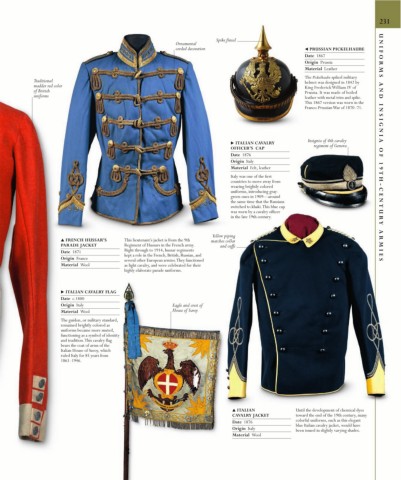
                                                                              Spike finial
                                                                Ornamental
                                                                corded decoration                             ◀ PRUSSIAN PICKELHAUBE
                                                                                                              Date  1867                UNIFORMS
                                                                                                              Origin  Prussia
                                                                                                              Material  Leather
                                                                                                              The Pickelhaube spiked military
             Traditional                                                                                      helmet was designed in 1842 by
             madder red color                                                                                 King Frederick William IV of
             of British                                                                                       Prussia. It was made of boiled
             uniforms                                                                                         leather with metal trim and spike.
                                                                                                              This 1867 version was worn in the
                                                                                                              Franco-Prussian War of 1870–71.


                                                                                                               Insignia of 4th cavalry
                                                                                   ▶ ITALIAN CAVALRY
                                                                                   OFFICER’S  CAP                regiment of Genova     AND INSIGNIA OF 19TH-CENTUR
                                                                                   Date  1876
                                                                                   Origin  Italy
                                                                                   Material  Felt, leather
                                                                                   Italy was one of the first
                                                                                   countries to move away from
                                                                                   wearing brightly colored
                                                                                   uniforms, introducing gray-
                                                                                   green ones in 1909—around
                                                                                   the same time that the Russians
                                                                                   switched to khaki. This blue cap
                                                                                   was worn by a cavalry officer
                                                                                   in the late 19th century.                            Y


                                                                             Yellow piping
                       ▲ FRENCH HUSSAR’S     This lieutenant’s jacket is from the 9th   matches collar
                       PARADE JACKET         Regiment of Hussars in the French army.   and cuffs                                        ARMIES
                       Date  1871            Right through to 1914, hussar regiments
                                             kept a role in the French, British, Russian, and
                       Origin  France        several other European armies. They functioned
                       Material  Wool        as light cavalry, and were celebrated for their
                                             highly elaborate parade uniforms.


                       ▶ ITALIAN CAVALRY FLAG
                       Date  c.1880
                       Origin  Italy                          Eagle and crest of
                       Material  Wool                         House of Savoy
                       The guidon, or military standard,
                       remained brightly colored as
                       uniforms became more muted,
                       functioning as a symbol of identity
                       and tradition. This cavalry flag
                       bears the coat of arms of the
                       Italian House of Savoy, which
                       ruled Italy for 85 years from
                       1861–1946.


                                                                                    ▲ ITALIAN             Until the development of chemical dyes
                                                                                    CAVALRY JACKET        toward the end of the 19th century, many
                                                                                    Date  1876            colorful uniforms, such as this elegant
                                                                                                          blue Italian cavalry jacket, would have
                                                                                    Origin  Italy         been issued in slightly varying shades.
                                                                                    Material  Wool

