


Page 232 - (DK) Smithsinian - Military History: The Definitive Visual Guide to the Objects of Warfare
P. 232
230

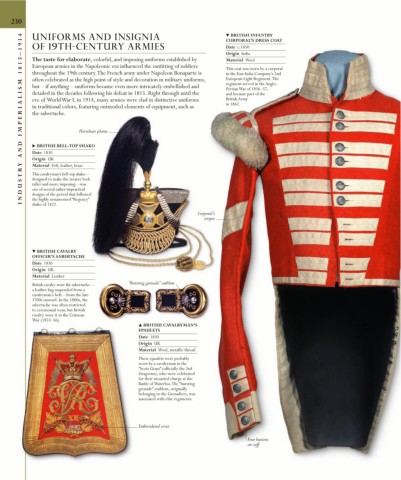
            UNIFORMS AND INSIGNIA                                                 ▼ BRITISH INFANTRY
         AND IMPERIALISM 1815–1914
                                                                                  CORPORAL’S DRESS COAT
            OF 19TH-CENTURY ARMIES                                                Date  c.1850
                                                                                  Origin  India
            The taste for elaborate, colorful, and imposing uniforms established by   Material  Wool
            European armies in the Napoleonic era influenced the outfitting of soldiers   This coat was worn by a corporal
            throughout the 19th century. The French army under Napoleon Bonaparte is   in the East India Company’s 2nd
            often celebrated as the high point of style and decoration in military uniforms,   European Light Regiment. The
            but—if anything—uniforms became even more intricately embellished and   regiment served in the Anglo-
                                                                                  Persian War of 1856–57,
            detailed in the decades following his defeat in 1815. Right through until the   and became part of the
            eve of  World War I, in 1914, many armies were clad in distinctive uniforms    British Army
            in traditional colors, featuring outmoded elements of equipment, such as    in 1862.
            the sabertache.


                             Horsehair plume

            ▶ BRITISH BELL-TOP SHAKO
            Date  1830
            Origin  UK
         Y   Material  Felt, leather, brass
         INDUSTR  designed to make the wearer look
            This cavalryman’s bell-top shako—
            taller and more imposing—was
            one of several rather impractical
            designs of the period that followed
            the highly ornamented “Regency”
            shako of 1822.
                                                                       Corporal’s
                                                                          stripes


            ▼ BRITISH CAVALRY
            OFFICER’S SABERTACHE
            Date  1830
            Origin  UK
            Material  Leather
            British cavalry wore the sabertache—   “Bursting grenade”  emblem
            a leather bag suspended from a
            cavalryman’s belt—from the late
            1700s onward. In the 1800s, the
            sabertache was often restricted
            to ceremonial wear, but British
            cavalry wore it in the Crimean
            War (1853–56).
                                                  ▲ BRITISH CAVALRYMAN’S
                                                  EPAULETS
                                                  Date  1830
                                                  Origin  UK
                                                  Material  Wool, metallic thread
                                                  These epaulets were probably
                                                  worn by a cavalryman in the
                                                  “Scots Grays” (officially the 2nd
                                                  Dragoons), who were celebrated
                                                  for their mounted charge at the
                                                  Battle of  Waterloo. The “bursting
                                                  grenade” emblem, originally
                                                  belonging to the Grenadiers, was
                                                  associated with elite regiments.


                                                  Embroidered cover

                                                                                         Four buttons
                                                                                         on cuff

