


Page 240 - (DK) Smithsinian - Military History: The Definitive Visual Guide to the Objects of Warfare
P. 240
238

            MUZZLE-LOADING ARTILLERY
         AND IMPERIALISM 1815–1914
            In the 19th century, infantrymen firing rifled small arms were able
            to achieve greater range than smoothbore cannon, so attempts were
            made to apply rifling to field artillery. The first rifled cannon
            were developed in the 1840s by pioneers including Giovanni Cavalli
            of Italy, Martin von Wahrendorff of Sweden, and Joseph Whitworth
            and Charles Lancaster of Britain. Some of these early rifled field
            guns—such as the rifled Whitworth 12-pounder, which saw service
            in the American Civil War—were breech- rather than muzzle-
            loaders. Breech-loaders permitted a higher rate of fire and were
            generally safer to use, but muzzle-loaders were cheaper to
            manufacture and required less expensive ammunition. As a result,
            muzzle-loaders continued to be popular for military use.
                                                                                                        Later
                                                                                                    replacement
                                                                                                       carriage

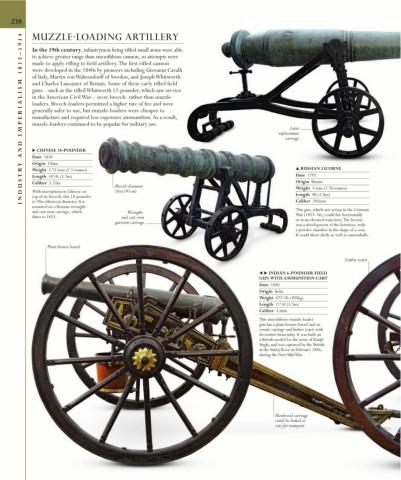
            ▶ CHINESE 18-POUNDER
            Date  1830
         Y   Origin  China                                                                                ▲ RUSSIAN LICORNE
         INDUSTR  Length  10 ⁄2ft (3.2m)  Muzzle diameter                                                 Date  1793
            Weight  2.75 tons (2.5 tonnes)
                    1
                                                                                                          Origin  Russia
            Caliber  5.25in
                                                                                                          Weight  3 tons (2.76 tonnes)
                                          16in (41cm)
            With inscriptions in Chinese on
                                                                                                          Length  9ft (2.8m)
            top of its breech, this 18-pounder
            is 19in (48cm) in diameter. It is
            mounted on a Russian wrought-                                                                 Caliber  205mm
            and cast-iron carriage, which     Wrought-                                                    This gun, which saw action in the Crimean
            dates to 1853.                  and cast-iron                                                 War (1853–56), could fire horizontally
                                          garrison carriage                                               or at an elevated trajectory. The licorne
                                                                                                          was a development of the howitzer, with
                                                                                                          a powder chamber in the shape of a cone.
                                                                                                          It could shoot shells as well as cannonballs.
                  Plain bronze barrel
                                                                                                                            Limber (cart)

                                                                                             ◀▶ INDIAN 6-POUNDER FIELD
                                                                                             GUN  WITH AMMUNITION CART
                                                                                             Date  1840
                                                                                             Origin  India
                                                                                                      1
                                                                                             Weight  672 ⁄2lb (305kg)
                                                                                                     1
                                                                                             Length  11 ⁄2ft (3.5m)
                                                                                             Caliber  3.66in
                                                                                             This smoothbore muzzle-loader
                                                                                             gun has a plain bronze barrel and an
                                                                                             ornate carriage and limber (cart) with
                                                                                             decorative brass inlay. It was built on
                                                                                             a British model for the army of Ranjit
                                                                                             Singh, and was captured by the British
                                                                                             at the Sutlej River in February 1846,
                                                                                             during the First Sikh War.


                                                                                                   Hardwood carriage
                                                                                                   could be linked to
                                                                                                   cart for transport

