


Page 238 - (DK) Smithsinian - Military History: The Definitive Visual Guide to the Objects of Warfare
P. 238
236

            INFANTRY AND CAVALRY
         AND IMPERIALISM 1815–1914
            SWORDS AND BAYONETS

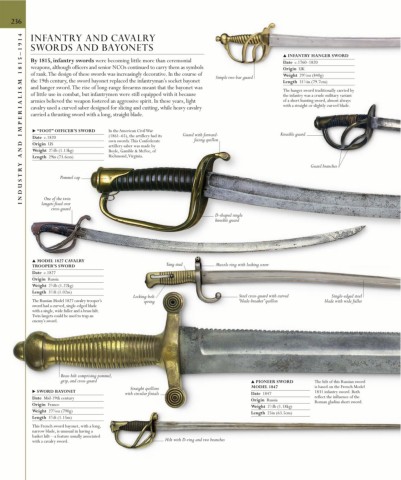
                                                                                                      ▲ INFANTRY HANGER SWORD
            By 1815, infantry swords were becoming little more than ceremonial                        Date  c.1760–1820
            weapons, although officers and senior NCOs continued to carry them as symbols             Origin  UK
            of rank. The design of these swords was increasingly decorative. In the course of         Weight  29 ⁄2oz (840g)
                                                                                                             1
                                                                              Simple two-bar guard
            the 19th century, the sword bayonet replaced the infantryman’s socket bayonet             Length  31 ⁄4in (79.7cm)
                                                                                                             1
            and hanger sword. The rise of long-range firearms meant that the bayonet was              The hanger sword traditionally carried by
            of little use in combat, but infantrymen were still equipped with it because              the infantry was a crude military variant
            armies believed the weapon fostered an aggressive spirit. In these years, light           of a short hunting sword, almost always
            cavalry used a curved saber designed for slicing and cutting, while heavy cavalry         with a straight or slightly curved blade.
            carried a thrusting sword with a long, straight blade.

            ▶ “FOOT” OFFICER’S SWORD    In the American Civil War                                    Knuckle guard
            Date  c.1820                (1861–65), the artillery had its    Guard with forward-
                                        own swords. This Confederate   facing quillon
            Origin  US                  artillery saber was made by
                   1
            Weight  2 ⁄2lb (1.13kg)     Boyle, Gamble & McFee, of
            Length  29in (73.6cm)       Richmond, Virginia.
         Y                                                                                                      Guard branches
         INDUSTR      Pommel cap


                 One of the twin
                langets fixed over
                   cross-guard
                                                                              D-shaped single
                                                                              knuckle guard


            ▲ MODEL 1827 CAVALRY
            TROOPER’S SWORD                                 Tang stud         Muzzle ring with locking screw
            Date  c.1827
            Origin  Russia
                   3
            Weight  2 ⁄4lb (1.22kg)
                   1
            Length  3 ⁄2ft (1.02m)
                                                Locking-bolt                          Steel cross-guard with curved    Single-edged steel
            The Russian Model 1827 cavalry trooper’s   spring                         “blade-breaker” quillon        blade with wide fuller
            sword had a curved, single-edged blade
            with a single, wide fuller and a brass hilt.
            Twin langets could be used to trap an
            enemy’s sword.


                       Brass hilt comprising pommel,
                       grip, and cross-guard                                              ▲ PIONEER SWORD        The hilt of this Russian sword
                                                                                          MODEL 1847             is based on the French Model
                                               Straight quillons
            ▶ SWORD BAYONET                                                                                      1831 infantry sword. Both
                                              with circular finials                       Date  1847
            Date  Mid-19th century                                                                               reflect the influence of the
                                                                                          Origin  Russia         Roman gladius short sword.
            Origin  France                                                                Weight  2 ⁄2lb (1.18kg)
                                                                                                 1
                    3
            Weight  27 ⁄4oz (790g)
                                                                                          Length  25in (63.5cm)
                   3
            Length  3 ⁄4ft (1.15m)
            This French sword bayonet, with a long,
            narrow blade, is unusual in having a
            basket hilt—a feature usually associated
            with a cavalry sword.                           Hilt with D-ring and two branches

