


Page 242 - (DK) Smithsinian - Military History: The Definitive Visual Guide to the Objects of Warfare
P. 242
240

                                         KEY DEVELOPMENT
         AND IMPERIALISM 1815–1914
              KEY EVENTS
              19th century
              ◼ 1830–48  France invades Algeria,   THE WARS OF EMPIRES
              but Abd el-Kadir leads resistance
              to the French occupation of the
              territory until forced to surrender    In the 19th century, a gulf opened up between the military technology of Europe
              in 1848.
                                         and North America, and the rest of the world. Preindustrial societies, such as
              ◼ 1845–72  Maori opposition   China, Japan, and Africa, could not withstand the firepower of imperial armies.
              to the British colonization of
              New Zealand is overcome in
              a series of hard-fought wars.   The armies of the world’s great powers underwent   they had achieved regional dominance by fighting
                                         a technological revolution between 1815 and 1914,  aggressive wars against neighboring peoples with
              ◼ 1857–58  A rebellion against
              British rule in India is put down    progressing from flintlock muskets to repeater    stabbing spears and cowhide shields. They mostly
              by armed force.            rifles firing metal cartridges, and from smoothbore   relied on the same equipment against an invading
                                         muzzle-loading cannon to rifled guns firing high-  British Army in 1879, using rifles only for a scattered
              ◼ 1860  A combined Anglo-French
              army invades China and occupies   explosive shells. Widely adopted in the1890s, the   volley, before charging to engage at close quarters.
              Beijing, looting and burning Chinese   Maxim gun—the first self-powered machine gun   Despite a victory at Isandlwana, the Zulu were
              imperial palaces.
                                         —became a symbol of technological progress and   soon forced to concede defeat due to casualties
                                         the alleged superiority of European civilization.   inflicted by British bullets and bayonets.
              ◼ 1868  In Japan, the Tokugawa
         Y    Shogunate ends and the period of   Steamships projected this increased firepower
         INDUSTR  which time Japan modernizes its   powers that had fallen behind in the race for military  Plains Indian tribes such as the Sioux, Cheyenne,
              the Meiji Restoration begins, during
                                         worldwide in campaigns waged on every continent.  FRONTIER BATTLES
                                                                                        Expanding their territory westward, the US fought
                                          Some wars of the imperialist era were between
              armed forces and society.
              ◼ 1876–77  In the Black Hills
                                                                                        and Arapaho from the 1860s to the 1880s. The
                                         modernization. The defeat of China by European
              War, Sioux warriors led by Crazy
              Horse mount the last serious
                                                                                        including repeater rifles, and steel knives—but
                                         1856–60, demonstrated how a country long at the
              resistance to the westward   forces, in the Opium Wars of 1839–42 and     Plains Indians used modern technology—firearms,
              expansion of the United States.
                                         forefront of technological innovation and military   they fought best with traditional bows and spears.
              ◼ 1879  At Rorke’s Drift, 150   organization could suddenly find itself defenseless
              British soldiers armed chiefly with   at a time of rapid change. Both China and Japan
              Martini-Henry rifles successfully    attempted to adopt the technology of the West, but
              resist repeated attacks by 4,000
              Zulu warriors.             China’s defeat by Japan in the war of 1894–95, and
                                         its invasion by European powers in response to the
              ◼ 1898  An Anglo-Egyptian army   Boxer rebellion of 1900, showed that the Chinese
              defeats the Sudanese Mahdists at
              Omdurman (see pp.250–51). The   had failed. Japan, in contrast, established itself as the
              Sudanese are cut down by rapid-fire   sole Asian modern military power after its victory
              rifles and Maxim guns.
                                         over Russia in 1904–05 (see pp.264–65), in which it
                                         deployed the latest military technology, from steel
              ◼ 1900  In the Boer War, Boer
              militia armed with the latest German   battleships and torpedo boats to machine guns,
              weapons inflict a notable defeat on   rifled artillery, and field telephones.
              the British Army at Spion Kop.
                                         BATTLES WITH TRIBES
                                         Other conflicts of the era led the armies of Europe
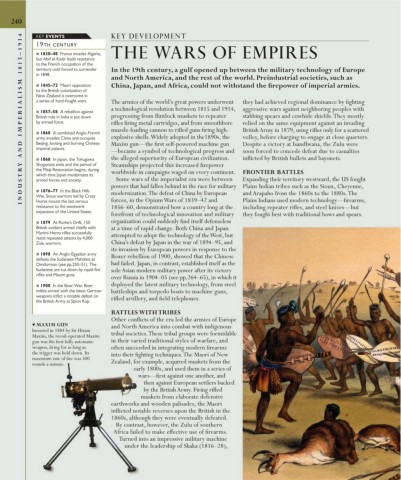
            ▼ MAXIM GUN                  and North America into combat with indigenous
            Invented in 1884 by Sir Hiram   tribal societies. These tribal groups were formidable
            Maxim, the recoil-operated Maxim
            gun was the first fully automatic   in their varied traditional styles of warfare, and
            weapon, firing for as long as    often succeeded in integrating modern firearms
            the trigger was held down. Its    into their fighting techniques. The Maori of New
            maximum rate of fire was 500    Zealand, for example, acquired muskets from the
            rounds a minute.
                                                 early 1800s, and used them in a series of
                                                  wars—first against one another, and
                                                    then against European settlers backed
                                                    by the British Army. Firing rifled
                                                   muskets from elaborate defensive
                                         earthworks and wooden palisades, the Maori
                                         inflicted notable reverses upon the British in the
                                         1860s, although they were eventually defeated.
                                          By contrast, however, the Zulu of southern
                                         Africa failed to make effective use of firearms.
                                           Turned into an impressive military machine
                                             under the leadership of Shaka (1816–28),

