


Page 294 - (DK) Smithsinian - Military History: The Definitive Visual Guide to the Objects of Warfare
P. 294
292    TRENCH WARFARE

         1914–1945  THE BATTLE


         ARS  OF ARRAS


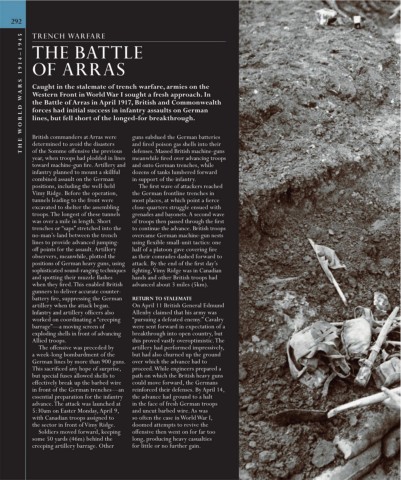
            Caught in the stalemate of trench warfare, armies on the

         ORLD W  Western Front in World War I sought a fresh approach. In
            the Battle of Arras in April 1917, British and Commonwealth
            forces had initial success in infantry assaults on German
            lines, but fell short of the longed-for breakthrough.
         THE W  British commanders at Arras were   guns subdued the German batteries

                                                and fired poison gas shells into their
            determined to avoid the disasters
            of the Somme offensive the previous
                                                defenses. Massed British machine-guns
            year, when troops had plodded in lines  meanwhile fired over advancing troops
            toward machine-gun fire. Artillery and  and onto German trenches, while
            infantry planned to mount a skillful   dozens of tanks lumbered forward
            combined assault on the German      in support of the infantry.
            positions, including the well-held    The first wave of attackers reached
            Vimy Ridge. Before the operation,   the German frontline trenches in
            tunnels leading to the front were   most places, at which point a fierce
            excavated to shelter the assembling   close-quarters struggle ensued with
            troops. The longest of these tunnels   grenades and bayonets. A second wave
            was over a mile in length. Short    of troops then passed through the first
            trenches or “saps” stretched into the   to continue the advance. British troops
            no-man’s-land between the trench    overcame German machine-gun nests
            lines to provide advanced jumping-   using flexible small-unit tactics: one
            off points for the assault. Artillery   half of a platoon gave covering fire
            observers, meanwhile, plotted the   as their comrades dashed forward to
            positions of German heavy guns, using  attack. By the end of the first day’s
            sophisticated sound-ranging techniques  fighting, Vimy Ridge was in Canadian
            and spotting their muzzle flashes   hands and other British troops had
            when they fired. This enabled British   advanced about 3 miles (5km).
            gunners to deliver accurate counter-
            battery fire, suppressing the German   RETURN TO STALEMATE
            artillery when the attack began.    On April 11 British General Edmund
            Infantry and artillery officers also   Allenby claimed that his army was
            worked on coordinating a “creeping   “pursuing a defeated enemy.” Cavalry
            barrage”—a moving screen of         were sent forward in expectation of a
            exploding shells in front of advancing   breakthrough into open country, but
            Allied troops.                      this proved vastly overoptimistic. The
               The offensive was preceded by    artillery had performed impressively,
            a week-long bombardment of the      but had also churned up the ground
            German lines by more than 900 guns.  over which the advance had to
            This sacrificed any hope of surprise,   proceed. While engineers prepared a
            but special fuses allowed shells to   path on which the British heavy guns
            effectively break up the barbed wire    could move forward, the Germans
            in front of the German trenches—an   reinforced their defenses. By April 14,
            essential preparation for the infantry   the advance had ground to a halt
            advance. The attack was launched at   in the face of fresh German troops
            5:30am on Easter Monday, April 9,   and uncut barbed wire. As was
            with Canadian troops assigned to    so often the case in World War I,
            the sector in front of Vimy Ridge.  doomed attempts to revive the
               Soldiers moved forward, keeping   offensive then went on for far too
            some 50 yards (46m) behind the      long, producing heavy casualties
            creeping artillery barrage. Other   for little or no further gain.

