


Page 298 - (DK) Smithsinian - Military History: The Definitive Visual Guide to the Objects of Warfare
P. 298
296
                                                                                                                    Track tension adjuster
            WORLD WAR I TANK
                                                                                            Radiator grille
         1914–1945  MARK V TANK                                                                                                6-pounder gun


            Tanks were first used by the British on the Somme in September 1916.
                                                                                                                            SIDE VIEW
                                                                                                track
         ARS   Early models were unreliable, but showed strong fighting potential.            Crawler   Machine-gun      Sponson  Access hatch
            Over 400 Mark Vs had entered service before the war’s end.
                                                                                                Access hatch
         ORLD W  last of the lozenge-shaped British heavy   also get stuck or break down. At the Battle
                                                     ground pitted with shell holes, they could
            The Mark V, introduced in 1918, was the
                                                     of Cambrai in 1917, around 324 British
            tanks to fight on the  Western Front. As
            with all of its predecessors, the Mark V’s
                                                     heavy tanks carried out a mass attack on
            thick armor reduced both its speed and
                                                     firm ground and demonstrated what the
         THE W  mobility. The tank was employed to lead   vehicle could achieve if properly used.   Exhaust pipe and muffler  PLAN VIEW
            infantry across no-man’s-land, smashing
                                                     Lighter, quicker tanks, such as the British
            a path through barbed wire and trenches.
                                                     Whippet and the French Renault FT-17—
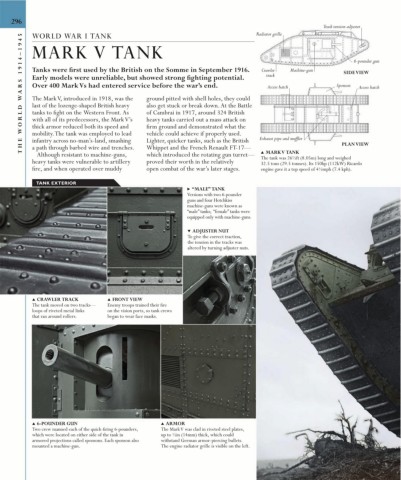
              Although resistant to machine-guns,    which introduced the rotating gun turret—  ▲ MARK V  TANK
            heavy tanks were vulnerable to artillery   proved their worth in the relatively    The tank was 26½ft (8.05m) long and weighed
                                                                                              32.5 tons (29.5 tonnes). Its 150hp (112kW) Ricardo
            fire, and when operated over muddy       open combat of the war’s later stages.   engine gave it a top speed of 4½mph (7.4 kph).

              TANK EXTERIOR
                                                                    ▶ “MALE”  TANK
                                                                    Versions with two 6-pounder
                                                                    guns and four Hotchkiss
                                                                    machine-guns were known as
                                                                    “male” tanks;  “female” tanks were
                                                                    equipped only with machine-guns.

                                                                    ▼ ADJUSTER NUT
                                                                    To give the correct traction,
                                                                    the tension in the tracks was
                                                                    altered by turning adjuster nuts.


            ▲ CRAWLER  TRACK           ▲ FRONT  VIEW
            The tank moved on two tracks—   Enemy troops trained their fire
            loops of riveted metal links    on the vision ports, so tank crews
            that ran around rollers.   began to wear face masks.


            ▲ 6-POUNDER GUN                               ▲ ARMOR
            Two crew manned each of the quick-firing 6-pounders,   The Mark V was clad in riveted steel plates,
            which were located on either side of the tank in   up to ½in (14mm) thick, which could
            armored projections called sponsons. Each sponson also   withstand German armor-piercing bullets.
            mounted a machine-gun.                        The engine radiator grille is visible on the left.

