


Page 352 - (DK) Smithsinian - Military History: The Definitive Visual Guide to the Objects of Warfare
P. 352
350                                 KEY DEVELOPMENT

         1914–1945                       TANKS AND INFANTRY


                                         IN WORLD WAR II


         ARS                             Land-based conflict in World War II extended across the globe, from

                                         the North African desert to the jungles of  New Guinea and the streets
         ORLD W  ▲ A SUITCASE RADIO      of Berlin.  Tanks and trucks made warfare more mobile, but did not

                                         eradicate the need for grueling infantry combat.
                                         Between the two World Wars, a number of
                                                                                        through Allied lines in the Ardennes. Mobile radios
         THE W  The British Mk III Suitcase Transceiver   army officers, including J. F. C. Fuller in the    solved the communication problems of  World War I,
            was designed for use by agents of
                                         UK, Heinz Guderian in Germany, and Mikhail
                                                                                        allowing generals to keep in touch with advancing
            Britain’s Special Operations Executive
                                         Tukhachevsky in the Soviet Union, explored the
                                                                                        forces, and facilitating combined ground and air
            (SOE) and resistance groups. All
            its components were miniaturized,
                                         in tank design—improving speed, reliability, and
                                                                                        were introduced, including mines, anti-tank guns,
            although it still required valves, as   use of tanks as the key strike force. Developments  maneuvers. As the war progressed, countermeasures
            transistors had not yet been invented.  armament—lent this vision credibility.   and infantry anti-tank weapons. The development
                                                                                        of self-propelled guns provided artillery support
                                         BLITZKREIG                                     for mobile forces, and also gave extra firepower to
                                         Nazi Germany gave fullest rein to armored war,   destroy advancing tanks.
                                         and defeated Allied ground forces in France in   Most infantry entered the war with the same
                                         May–June 1940. Using their Blitzkreig (“lightning   bolt-action rifles issued in World War I, although
                                         war”) tactics, German tanks and motorized infantry,  the US Army had adopted the semi-automatic M1
                                         supported by aircraft as “aerial artillery,” broke   Garand in 1936. By the end of the war, German

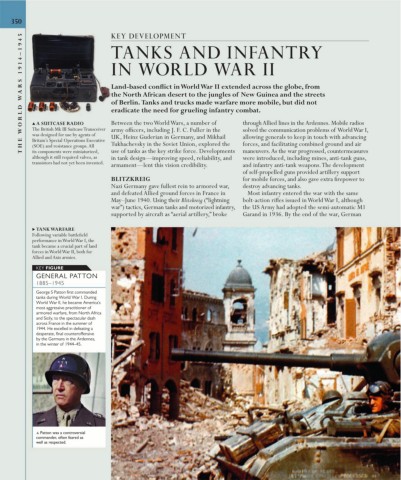
            ▶ TANK WARFARE
            Following variable battlefield
            performance in World War I, the
            tank became a crucial part of land
            forces in World War II, both for
            Allied and Axis armies.

              KEY FIGURE
              GENERAL PATTON
              1885–1945
              George S Patton first commanded
              tanks during World War I. During
              World War II, he became America’s
              most aggressive practitioner of
              armored warfare, from North Africa
              and Sicily, to the spectacular dash
              across France in the summer of
              1944. He excelled in defeating a
              desperate, final counteroffensive
              by the Germans in the Ardennes,
              in the winter of 1944–45.


              ▲ Patton was a controversial
              commander, often feared as
              well as respected.

