


Page 353 - (DK) Smithsinian - Military History: The Definitive Visual Guide to the Objects of Warfare
P. 353
351


            troops had the Sturmgewehr, the first assault                                                                               T
            rifle. Heavy, general-purpose, and light machine-  “The real secret is speed—speed of attack
            guns were ubiquitous, as were submachine-guns,                                                                              ANKS
            including the British Sten and the American    through speed of communication”
            Thompson (“Tommy”) gun. Cavalry were mostly
            absent, although some armies still used horse-drawn                    GENERAL ERHARD MILCH, DISCUSSING BLITZKRIEG, 1939
            supply trains—Germany assembled over 600,000                                                                                AND INF
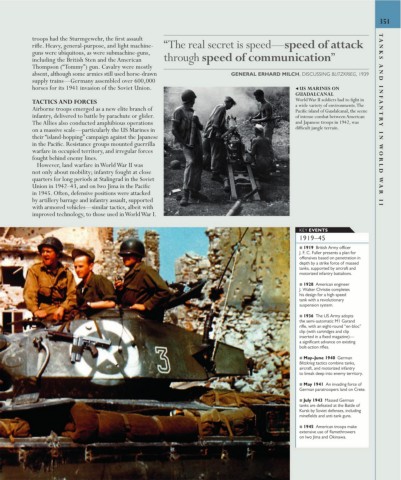
            horses for its 1941 invasion of the Soviet Union.                                             ◀ US MARINES ON
                                                                                                          GUADALCANAL
            TACTICS AND FORCES                                                                            World War II soldiers had to fight in
            Airborne troops emerged as a new elite branch of                                              a wide variety of environments. The   ANTR
                                                                                                          Pacific island of Guadalcanal, the scene
            infantry, delivered to battle by parachute or glider.                                         of intense combat between American
            The Allies also conducted amphibious operations                                               and Japanese troops in 1942, was
            on a massive scale—particularly the US Marines in                                             difficult jungle terrain.
            their “island-hopping” campaign against the Japanese                                                                        Y IN  W
            in the Pacific. Resistance groups mounted guerrilla
            warfare in occupied territory, and irregular forces
            fought behind enemy lines.
              However, land warfare in World War II was                                                                                 ORLD  W
            not only about mobility; infantry fought at close
            quarters for long periods at Stalingrad in the Soviet
            Union in 1942–43, and on Iwo Jima in the Pacific
            in 1945. Often, defensive positions were attacked                                                                           AR II
            by artillery barrage and infantry assault, supported
            with armored vehicles—similar tactics, albeit with
            improved technology, to those used in World War I.


                                                                                                            KEY EVENTS
                                                                                                            1919–45
                                                                                                            ◼ 1919  British Army officer
                                                                                                            J. F. C. Fuller presents a plan for
                                                                                                            offensives based on penetration in
                                                                                                            depth by a strike force of massed
                                                                                                            tanks, supported by aircraft and
                                                                                                            motorized infantry battalions.

                                                                                                            ◼ 1928  American engineer
                                                                                                            J. Walter Christie completes
                                                                                                            his design for a high-speed
                                                                                                            tank with a revolutionary
                                                                                                            suspension system.

                                                                                                            ◼ 1936  The US Army adopts
                                                                                                            the semi-automatic M1 Garand
                                                                                                            rifle, with an eight-round “en-bloc”
                                                                                                            clip (with cartridges and clip
                                                                                                            inserted in a fixed magazine)—
                                                                                                            a significant advance on existing
                                                                                                            bolt-action rifles.
                                                                                                            ◼ May–June 1940  German
                                                                                                            Blitzkrieg tactics combine tanks,
                                                                                                            aircraft, and motorized infantry
                                                                                                            to break deep into enemy territory.
                                                                                                            ◼ May 1941  An invading force of
                                                                                                            German paratroopers land on Crete.

                                                                                                            ◼ July 1943  Massed German
                                                                                                            tanks are defeated at the Battle of
                                                                                                            Kursk by Soviet defenses, including
                                                                                                            minefields and anti-tank guns.
                                                                                                            ◼ 1945  American troops make
                                                                                                            extensive use of flamethrowers
                                                                                                            on Iwo Jima and Okinawa.

