


Page 356 - (DK) Smithsinian - Military History: The Definitive Visual Guide to the Objects of Warfare
P. 356
354    AXIS ARMORED                                                                                            Also armed with a

         1914–1945  FIGHTING VEHICLES                                      20mm KwK                                 7.92mm machine-gun


                                                                            30 cannon
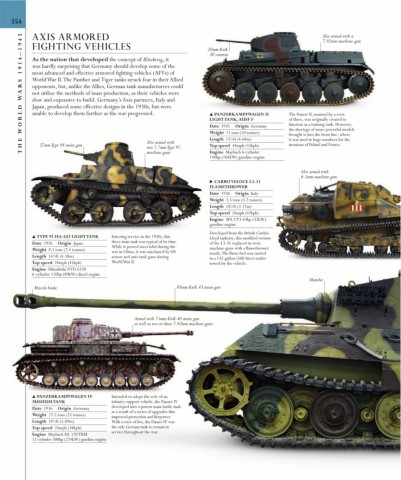
            As the nation that developed the concept of Blitzkrieg, it
            was hardly surprising that Germany should develop some of the

         ARS   most advanced and effective armored fighting vehicles (AFVs) of
            World War II. The Panther and  Tiger tanks struck fear in their Allied
            opponents, but, unlike the Allies, German tank manufacturers could
            not utilize the methods of mass production, as their vehicles were
         ORLD W  slow and expensive to build. Germany’s Axis partners, Italy and   ▲ PANZERKAMPFWAGEN II   The Panzer II, manned by a crew
            Japan, produced some effective designs in the 1930s, but were
            unable to develop them further as the war progressed.
                                                                            LIGHT TANK, AUSF F
                                                                                                        of three, was originally created to
                                                                                                        function as a training tank. However,
         THE W  37mm Type 98 main gun                Also armed with        Date  1935     Origin  Germany  the shortage of more powerful models
                                                                            Weight  11 tons (10 tonnes)
                                                                                                        brought it into the front line, where
                                                                            Length  15 ⁄4ft (4.64m)
                                                                                   1
                                                                                                        it was used in huge numbers for the
                                                                                                        invasions of Poland and France.
                                                                            Top speed  34mph (55kph)
                                                     two 7.7mm Type 97
                                                                            Engine  Maybach 6-cylinder
                                                     machine-guns
                                                                            140hp (104kW) gasoline engine
                                                                                                            Also armed with
                                                                                                            6.5mm machine-gun
                                                                            ▶ CARRO VELOCE L3-33
                                                                            FLAMETHROWER
                                                                            Date  1936     Origin  Italy
                                                                            Weight  3.5 tons (3.2 tonnes)
                                                                            Length  10 ⁄2ft (3.17m)
                                                                                   1
                                                                            Top speed  26mph (42kph)
                                                                            Engine  SPA CV3 43hp (32kW)
                                                                            gasoline engine
                                                                            Developed from the British Carden-
            ▲ TYPE 95 HA-GO LIGHT TANK   Entering service in the 1930s, this   Lloyd tankette, this modified version
            Date  1936     Origin  Japan  three-man tank was typical of its time.   of the L3-35 replaced its twin
                                         While it proved successful during the   machine-guns with a flamethrower
            Weight  8.1 tons (7.4 tonnes)
                                         war in China, it was outclassed by US   nozzle. The flame fuel was carried
                    1
            Length  14 ⁄4ft (4.38m)      armor and anti-tank guns during    in a 132-gallon (500-liter) trailer
            Top speed  28mph (45kph)     World War II.                      towed by the vehicle.
            Engine  Mitsubishi NVD 6120
            6-cylinder 120hp (89kW) diesel engine
                                                                                                               Mantlet
             Muzzle brake                                       88mm KwK 43 main gun


                                                 Armed with 75mm KwK 40 main gun
                                                 as well as two or three 7.92mm machine-guns


            ▲ PANZERKAMPFWAGEN IV        Intended to adopt the role of an
            MEDIUM TANK                  infantry support vehicle, the Panzer IV
                                         developed into a potent main battle tank
            Date  1936     Origin  Germany
                                         as a result of a series of upgrades that
            Weight  27.5 tons (25 tonnes)
                                         improved protection and firepower.
                    1
            Length  19 ⁄4ft (5.89m)      With a crew of five, the Panzer IV was
            Top speed  24mph (38kph)     the only German tank to remain in
                                         service throughout the war.
            Engine  Maybach HL 120 TRM
            12-cylinder 300hp (224kW) gasoline engine

