


Page 381 - (DK) Smithsinian - Military History: The Definitive Visual Guide to the Objects of Warfare
P. 381
379

                                                               NUCLEAR WARFARE
                                                               THE BOMBING OF


                                                               HIROSHIMA


                                                               When US aircraft dropped atom bombs on the Japanese cities               THE BOMBING OF HIR
                                                               of Hiroshima and Nagasaki in August 1945 in a bid to end
                                                               World War II, it opened a new perilous chapter in the history
                                                               of warfare. For the first time, weapons had been created that
                                                               were so destructive that their use had to be avoided at all costs.


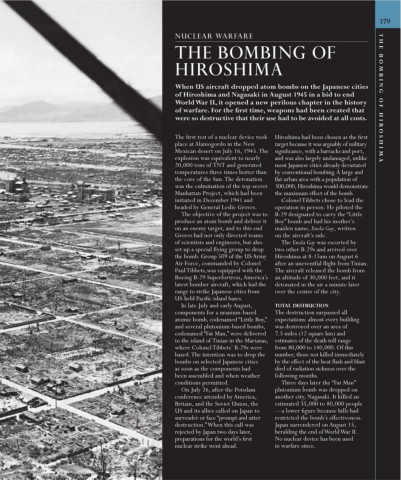
                                                               The first test of a nuclear device took  Hiroshima had been chosen as the first
                                                               place at Alamogordo in the New      target because it was arguably of military   OSHIMA
                                                               Mexican desert on July 16, 1945. The  significance, with a barracks and port,
                                                               explosion was equivalent to nearly   and was also largely undamaged, unlike
                                                               20,000 tons of  TNT and generated   most Japanese cities already devastated
                                                               temperatures three times hotter than   by conventional bombing. A large and
                                                               the core of the Sun. The detonation   flat urban area with a population of
                                                               was the culmination of the top-secret  300,000, Hiroshima would demonstrate
                                                               Manhattan Project, which had been   the maximum effect of the bomb.
                                                               initiated in December 1941 and        Colonel Tibbets chose to lead the
                                                               headed by General Leslie Groves.    operation in person. He piloted the
                                                                  The objective of the project was to  B-29 designated to carry the “Little
                                                               produce an atom bomb and deliver it   Boy” bomb and had his mother’s
                                                               on an enemy target, and to this end   maiden name, Enola Gay, written
                                                               Groves had not only directed teams   on the aircraft’s side.
                                                               of scientists and engineers, but also   The Enola Gay was escorted by
                                                               set up a special flying group to drop   two other B-29s and arrived over
                                                               the bomb. Group 509 of the US Army   Hiroshima at 8:15am on August 6
                                                               Air Force, commanded by Colonel     after an uneventful flight from Tinian.
                                                               Paul Tibbets,was equipped with the   The aircraft released the bomb from
                                                               Boeing B-29 Superfortress, America’s  an altitude of 30,000 feet, and it
                                                               latest bomber aircraft, which had the   detonated in the air a minute later
                                                               range to strike Japanese cities from   over the center of the city.
                                                               US-held Pacific island bases.
                                                                  In late July and early August,   TOTAL DESTRUCTION
                                                               components for a uranium-based      The destruction surpassed all
                                                               atomic bomb, codenamed “Little Boy,”  expectations: almost every building
                                                               and several plutonium-based bombs,   was destroyed over an area of
                                                               codenamed “Fat Man,” were delivered   7.5 miles (12 square km) and
                                                               to the island of  Tinian in the Marianas,  estimates of the death toll range
                                                               where Colonel Tibbets’ B-29s were   from 80,000 to 140,000. Of this
                                                               based. The intention was to drop the   number, those not killed immediately
                                                               bombs on selected Japanese cities    by the effect of the heat flash and blast
                                                               as soon as the components had       died of radiation sickness over the
                                                               been assembled and when weather     following months.
                                                               conditions permitted.                 Three days later the “Fat Man”
                                                                  On July 26, after the Potsdam    plutonium bomb was dropped on
                                                               conference attended by America,     another city, Nagasaki. It killed an
                                                               Britain, and the Soviet Union, the    estimated 35,000 to 80,000 people
                                                               US and its allies called on Japan to   —a lower figure because hills had
                                                               surrender or face “prompt and utter   restricted the bomb’s effectiveness.
                                                               destruction.” When this call was    Japan surrendered on August 15,
                                                               rejected by Japan two days later,   heralding the end of World War II.
                                                               preparations for the world’s first   No nuclear device has been used
                                                               nuclear strike went ahead.          in warfare since.

