


Page 386 - (DK) Smithsinian - Military History: The Definitive Visual Guide to the Objects of Warfare
P. 386
384      KEY STRUCTURE              KEY DEVELOPMENT

         GE 1945–PRESENT  SHELTER        THE COLD WAR ERA
              NUCLEAR


              Away from the cataclysmic center
              of a nuclear explosion, people
                                         The end of  World War II witnessed the emergence of the Soviet Union
              sheltering in deep underground
              bunkers would have a chance of
                                         and the US as global superpowers, and their ideological hostility was
              survival. But the ensuing radioactive
                                         to define international politics for the remainder of the 20th century.
              fallout would force survivors to
              periods, requiring supplies of
              uncontaminated food, water,
              and recyclable air.
                                         made especially dangerous by the advent of nuclear
                                                                                        the blast from the first hydrogen explosion was
         A    remain underground for extended   The enmity between these two superpowers was   invented the hydrogen bomb in the mid-1950s:
                                                                                        measured at 10.4 megatons, 450 times more
                                         weapons. The US, the first of the two nations to
         THE NUCLEAR                     to devastating effect against the Japanese cities of   bomber aircraft, but their vulnerability to air-
                                         develop an atomic bomb, used its nuclear supremacy  powerful than the bomb dropped on Nagasaki.
                                                                                         Nuclear weapons were initially carried in
                                         Hiroshima (see pp.378–79) and Nagasaki in 1945; it
                                         lost its lead in 1949, however, when the Soviet Union  defense systems soon became apparent. The
                                         developed its own atomic bomb. This marked the
                                                                                        solution was to supplement the use of bombers
                                         beginning of an arms race, as the two superpowers
                                                                                        with ballistic missiles, which were difficult to
                                                                                        intercept. They could be fired from concealed
                                         developed ever-more powerful weapons and more
              ▲ This nuclear bunker was built in   complex and accurate delivery systems. Scientists   concrete silos and had the range to hit population
              Moscow in 1956, anticipating the
              fear of an all-out nuclear conflict.


              KEY EVENTS
              1945–1955
              ◼ August 6, 1945  A US B-29
              aircraft drops an atomic bomb
              on Hiroshima, marking a new
              era of nuclear warfare.
              ◼ May 22, 1947  President
              Harry S. Truman commits the US
              to providing military assistance to
              any nation threatened by Communist
              aggression. This becomes known
              as the Truman Doctrine.
              ◼ April 4, 1949  The North
              Atlantic Treaty Organization
              (NATO) is formed, to provide
              a military bulwark against the
              Soviet Union.

              ◼ November 1, 1952  The US
              carries out the first successful test of
              a hydrogen bomb, on the Eniwetok
              atoll in the Pacific. The Soviet Union
              follows suit in 1953.

              ◼ May 14, 1955  The Warsaw Pact
              is agreed, a mutual defense treaty
              between the Soviet Union and the
              Communist states of eastern Europe.


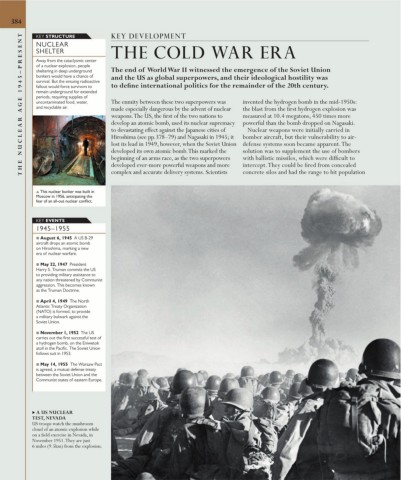
            ▶ A US NUCLEAR
            TEST, NEVADA
            US troops watch the mushroom
            cloud of an atomic explosion while
            on a field exercise in Nevada, in
            November 1951. They are just
            6 miles (9.5km) from the explosion.

